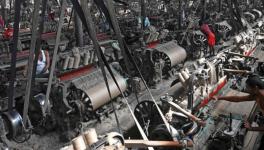






Bengal: Jute Industry Reeling in Deep Crisis
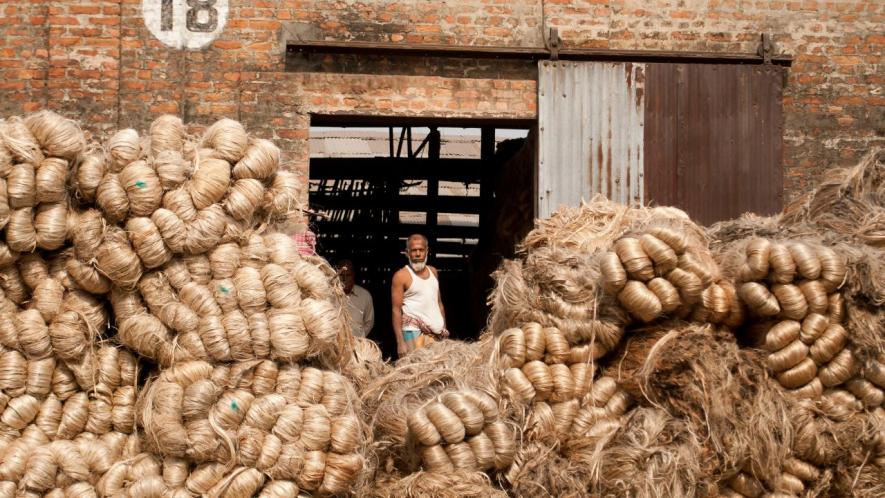
representational image. Image Courtesy: Pexels
Kolkata: At a time when labour-intensive industries in West Bengal are shutting down one after another, employment opportunities are shrinking and unemployment is steadily rising, the jute industry still remains the primary means of livelihood for lakhs of people. Even today, this industry provides the basic means of survival for a vast number of workers and their families. And yet, this very industry is now passing through its deepest crisis.
This crisis is not the result of any natural disaster, nor is it an unavoidable outcome of economic necessity. It is the product of long-standing policy decisions, systematic neglect, and the steady surrender of the state to corporate interests.
The jute industry is not merely a production sector in Bengal’s economic history; it has been the backbone of Bengal’s industrial development. In the early 20th century, jute was the foremost among the few industries that Bengal could take pride in. At one point, nearly half of Bengal’s industrial workforce was employed in this sector, and jute exports accounted for almost one-third of the region’s total export earnings. The industrial belt along the Hooghly river was not only a centre of production, but also home to a vast working-class population—out of which emerged Bengal’s modern labour movement.
However, since the country’s Partition, the industry has been pushed into a continuous crisis. A large portion of raw jute cultivation went to East Pakistan (now Bangladesh), while most of the mills remained in West Bengal. After Independence, British capital was replaced by Indian business houses, but there was no fundamental change in the character of industrial management. Instead, new forms of labour exploitation were introduced in the pursuit of short-term profit—casualisation, fragmentation, and contract-based employment. Although trade union struggles won certain labour protections, these gains have been systematically dismantled over the past decade.
Today, around three lakh workers are directly employed in West Bengal’s jute mills, while nearly 35 lakh people depend on the industry indirectly. Yet this enormous population lives under conditions of extreme insecurity. Mills are shutting down one after another; shifts are being reduced; in many places work is stopped indefinitely, effectively rendering workers unemployed. Every day, workers arrive at mill gates fearing that a notice of suspension of work will be issued.
A major aspect of this crisis is the blatant violation of labour laws and tripartite agreements. According to the 1984 agreement, jute mills were supposed to have 90% permanent workers and 20% permanent badli workers. In reality, this ratio has been completely overturned. The majority of workers today are hired through contractors, agencies, or voucher-based “daily paid” arrangements—their names do not even appear in the mill registers. This is not merely exploitation; it is the erasure of workers’ legal existence.
Alongside this is the long-standing crisis of categorisation. Since 1995, workers have not been graded according to skill. As a result, even skilled workers continue to receive unskilled wages and benefits year after year. Without proper categorisation, no wage agreement can genuinely benefit workers—a fact well understood by the managements, which is precisely why the issue is deliberately avoided.
Wage structures reveal the depth of exploitation. According to data from the Indian Jute Mills Association, as new workers have been recruited, daily wages have declined—while workloads have increased. This is not a natural market process; it is a deliberate strategy to depress the value of labour.
The condition of social security for workers is equally alarming. In many mills, ESI and provident fund (PF) contributions are not deposited. Retired workers do not receive PF or pensions; gratuity remains largely illusory. This is not just a financial crisis—it is a direct assault on the dignity of workers’ lives.
The tripartite agreement signed in 2024 between workers, owners, and the government was meant to establish a minimum framework of stability and justice in the jute industry. In practice, however, most of its crucial provisions have not been implemented. Despite clear commitments on grade and scale determination, workers have received no real benefits.
Provisions regarding permanent and special badli workers exist only on paper, depriving thousands of legal security and safety. Even worse, provident fund and gratuity dues for eligible workers remain unpaid in huge amounts.
Alongside agreement violations, the burden of so-called “modernisation” has been imposed on workers in the form of intensified production. Under the tripartite agreement, determining the man–machine ratio was the responsibility of the State Productivity Council (SPC), to ensure balance between technological development and employment. But taking advantage of government indifference, mill owners have selectively and unilaterally used SPC reports—completely ignoring questions of employment, health, and safety. The result has been rising job insecurity, abnormal work pressure, and an increasing rate of industrial accidents. So-called modernisation has become a new threat to workers’ livelihoods and lives.
This crisis is further intensified by the severe shortage of raw jute. At present, around 17 mills are completely shut, and an estimated 50,000–60,000 workers face unemployment. This shortage is not natural. The government itself admits that demand and orders exist, but supply does not—meaning the crisis has been artificially created. Recent raids by the Jute Commissioner’s office have uncovered massive hoarding of raw jute, proving that black-marketing and stockpiling are at the root of the problem.
In this situation, the role of the Jute Corporation of India (JCI) is crucial. If JCI procures raw jute directly and on a large scale, farmers will receive fair prices, hoarding will be curbed, and mills will have assured supply. Without an active JCI, this crisis cannot be resolved.
Central government policy decisions have further deepened the crisis. The approval of 9.22 lakh HDPE/PP plastic bags for foodgrain procurement under RMS 2026–27 is a direct blow to the jute industry. On one hand, the government speaks of environmental protection; on the other, it promotes petroleum-based plastics over renewable and biodegradable jute. This is not inconsistency—it is a policy driven by corporate interests.
Added to this is the discriminatory structure of India-Bangladesh trade. While Bangladeshi goods freely enter India, Indian goods face severe restrictions in Eastern India, limited to a handful of designated ports. As a result, mills in Eastern India are hit from both sides—raw material shortages and restricted markets. This is not balanced trade policy; it is deliberate diversion.
The current crisis strikes both jute farmers and jute workers simultaneously. Farmers are forced to sell at low prices, while workers face mill closures, unemployment, and wage insecurity. Attempts to divide farmers and workers will ultimately destroy the industry. The only path forward is united struggle.
To save the jute industry, immediate and coordinated action is essential. With active intervention by the West Bengal government, urgent discussions must be held with the Union Ministries of Textiles and Commerce, involving owners and trade unions. Ensuring raw jute supply, stopping hoarding, fully implementing the tripartite agreement, guaranteeing categorisation and minimum wages, and restoring social security—only these steps can protect this historic industry from destruction.
It is in this context that the call for the jute strike on January 12 this year carried special historical significance. The strike was not withdrawn; it was temporarily suspended—a clear strategic decision in the history of the labour movement. Workers have made it clear that this is not a one-day outburst, but the beginning of a long, organised struggle.
The demand to declare lay-off within 21 days for workers of closed mills is, therefore, both logical and urgent. Where mills operate nominally but deny regular work, legal lay-off provisions must be enforced so that workers receive minimum legal protection. These demands are fundamentally about the right to survive.
The jute industry crisis is not merely an industrial problem. It is a larger struggle over the dignity of labour, the right to employment, and the future of Bengal’s industry-based economy. The struggle is long and difficult—but unavoidable. And history shows again and again: when workers and farmers stand divided, rulers and corporate interests prevail; when they unite, change becomes inevitable.
The writer is the working president of Bengal Chatkal Mazdoor Union and a senior leader of Centre of Indian Trade Unions in West Bengal
Get the latest reports & analysis with people's perspective on Protests, movements & deep analytical videos, discussions of the current affairs in your Telegram app. Subscribe to NewsClick's Telegram channel & get Real-Time updates on stories, as they get published on our website.