





Book Review: Money, Banking and Finance in India
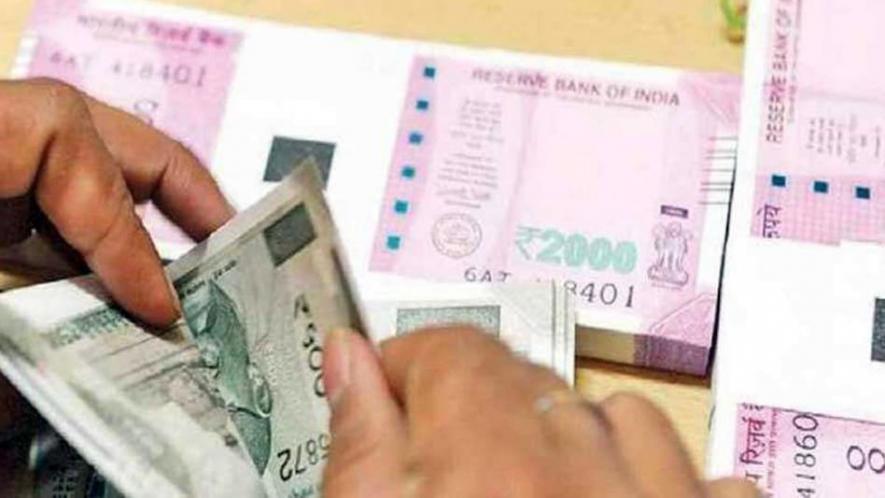
Representational Image. Image Courtesy: PTI
For any modern economy, there exist two crucial elements: firstly, money at the core and secondly, a monetary or financial system that lets money show its full potentialities. The issues of financial inclusion and financial stability are outcomes of the financial system that have been debated without any final outcome. India has been through an evolution of money and financial system since the Gupta Period (3rd to 6th century). After intermittent debacles, a uniform system during the Mughal era was taken over by the British empire to drain India's wealth. More organised monetary management started with the establishment of the Reserve Bank of India (RBI) on April 1, 1935.
Money and banking in India are complex phenomenon evolved over a long period and requires impeccable understanding of its foundations. It is in this context that the book "Foundation of Money and Banking in India" by Prof. Ankur Bhatnagar and Prof. C. Saratchand (Primus Book, Delhi; January 2026; 646 pages) serves the purpose of building a sound and organised understanding. It blends theoretical rigor with historical analysis, focusing on India's experience since independence in 1947. The authors describe it as a "synthetic outcome of a persistent academic dialogue", negotiating between mathematical models and non-mathematical expositions to make complex ideas accessible. The foreword, by eminent economist Prof. Prabhat Patnaik, sets a critical tone, arguing that in developing economies like India, fiscal policies have been ignored as effective pro-cyclical economic interventions and monetary policy intervention has been considered as a key lever for stability in the era of dominance of global finance. According to Prof. Patnaik, the book makes readers aware about the functioning of financial and monetary models which will be useful to understand the possible implications of financial and monetary policies practiced during this era.
The book is organised into five sections, each building on the last to provide a layered understanding. This reflects a logical progression from foundational concepts to applied Indian scenarios, enriched by numerous boxes, figures, and tables.
Money in Today’s World
Section I, Money: Concept, Theory and Measurement, lays the groundwork. This section clarifies how economic activities in an economy are determined by the presence of money and what are its basic characteristics that make money so significant for an individual and the country. We have witnessed emergence of crypto currencies as the recent development in the monetary and financial system across the world that are being used as digital medium of exchange for online and peer to peer transactions bypassing the role of national/fiat currency as also the role of central banking. According to the Cryptocurrency Market Report-2026, the projected growth rate of the size of cryptocurrency market was 17 percent during 2025-26 and is estimated to reach up to USD 3.35 billion in 2026. The book does have discussion on such latest development in the monetary world and its possible fallout. It also discusses Fintech in which India has been a leader as far as the extent of transactions is concerned triggered by demonetization in 2016. However, the share of cash circulation as percentage of GDP has gone up from 11.6 percent in 2015 to 13.7 percent in 2022 as per the book, defying one of the purposes of demonetization. This section stands out for its balance of economic theories and Indian specificity, incorporating discussions on fintech, crypto, and Central Bank Digital Currency (CBDC).
Financial Systems
The global economy that has been through one crisis after another triggered by the exponential growth of the financial instruments and their size in the name of financial innovation with an objective of risk reduction. The sub-prime crisis of 2008 has been the latest event that shook the global economic world and brought misery in India too, leading to stagnation and inflation in the later part of the UPA-II and finally causing its ouster from the central government. UPA-II also relied on monetary and financial tools mainly to overcome the stagnation in the economy leading to unsustainable build-up of Non-Performing Assets (NPAs) of the banking sector in India. But post-UPA-II, during the current political dispensation, NPAs might have come down but that has been possible only with slower GDP growth rate even though India is the fastest growing major economy in world as per the latest data.
The second section of the book is all about the prototypes of the financial system to the current structure of the financial system that world and India are characterised by, with evidence of financial crisis and bringing into the discussion one of the leading economists Hyman P. Minsky and his work on genesis of financial crisis. Such interweaving of theory and empirics is rare in textbooks from India's perspective.
Demystifying Interest Rates
Global domination of finance and its repercussions for developing economies is reflected in the interest policies of these countries. It has been continuously seen that developing countries adjust their interest rate as per the adjustment in federal rate of the USA to adjust the capital flight as per their needs. This trend raises the question on true sovereignty of a country and independence of its central banking. The recent rise of outflow of foreign capital to the magnitude of approximately USD 19 billion in 2025 is an indication of what happens when a developing country does not adjust its interest rate to the US federal bank rate as desired by global rentiers. Section III of the book deals with such issues with special reference to the whole notion of interest rate and its determination in the setting of Indian context. This Section excels in demystifying interest rates through graphics and Indian examples, though the mathematical models might intimidate non-economics majors.
Banking Sector and Monetary Policy
The final two sections of the book are about banking sector in India and monetary policy formulation by the central bank. It gives detailed functioning of role of banks and the central bank in an economy. The book goes beyond discussion of commercial and cooperative banking and brings into discussion new trends that have emerged on the financial horizon of India with greater possibility of instability, uncertainty and non-transparent financing of business expansion. Some of the important topics which any student of economics must understand such as functioning and objectives of Monetary Policy Committee in India makes this very useful.
Global Theory to Local Practice
Overall, the book's strengths are manifold. Its integration of theory with Indian empirics, supported by over 100 graphics, fosters critical thinking. The focus on financial development since 1947, including demonetization and fintech, fills a gap in India-centric textbooks. Another important aspect is introducing basic concepts of Islamic banking, present in 60 countries, which brings in an aspect of banking not guided by profit maximisation. The breadth of the book, covering cryptos to crises, could overwhelm beginners, and the mathematical elements assume prior knowledge. Data in places only include figures up to 2022, which might limit its utility amid fast-changing events. While it includes comparative discourse related to USA and China, it could have also discussed emerging markets like Brazil or South Africa. The index is a good addition, and each chapter ends with quizzes, review questions, and references.
In conclusion, "Foundations of Money and Banking in India" is a robust, insightful textbook that demystifies a complex field for not only Indian readers but anyone who holds interest in the world of money and finance in Indian context. It acts as a bridge between global theory and local practice, ideal for undergraduate and postgraduate students, policymakers, and economists.
The writer is Associate Professor at Shri Ram College of Commerce, University of Delhi. The views are personal.
Get the latest reports & analysis with people's perspective on Protests, movements & deep analytical videos, discussions of the current affairs in your Telegram app. Subscribe to NewsClick's Telegram channel & get Real-Time updates on stories, as they get published on our website.