





Green Industrial Policy: Climate Ambition or New Inequality?
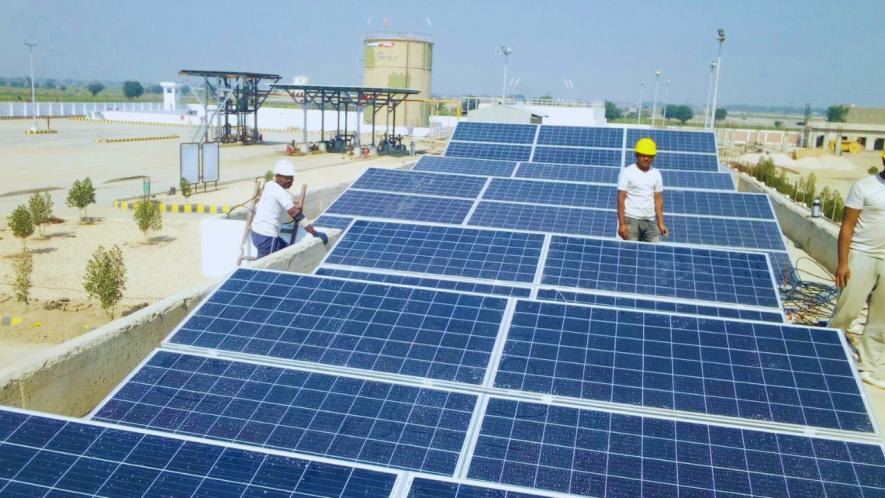
Representative image. Image Courtesy: Pexels
India no longer speaks about climate action in terms of prudence. It is speaking industrial language. Solar parks dot the desert, battery gigafactories are announced with great fanfare, and green hydrogen corridors promise to make India a global hub for sustainable manufacturing. The State is not only keeping pollution in check, but it is also changing the way markets work.
This move shows that green industrial strategy is becoming more popular. This is a strategic combination of climate ambition and economic nationalism. India is betting that it can use Production Linked Incentive (PLI) schemes, capital subsidies, viability gap assistance, and public procurement guarantees to help the economy change, while also reducing carbon emissions.
But there is a harder question underneath this hope: who benefits from this change, and who pays for it?
From Climate Commitment to Industrial Strategy
India's amended Nationally Determined Contributions (NDCs) commit the government to generating 50% of its installed energy from non-fossil sources and significantly reducing emissions intensity by 2030. However, the domestic political vocabulary has shifted from climate diplomacy to economic competition.
PLI plans for Advanced Chemistry Cell (ACC) batteries, high-efficiency solar photovoltaic (PV) modules, and green hydrogen are more than just climate solutions; these are tools for industrial self-sufficiency. The goal is clear: minimise reliance on imports (especially those from China), enhance domestic manufacturing, and integrate India into burgeoning clean-energy supply chains.
This is a trend that is happening all over the world. The Inflation Reduction Act in the US, the Green Deal Industrial Plan in the EU, and China's long-standing clean-tech subsidies have made climate action a competition between countries. India is doing the same thing.
Green growth is no longer just on the edges. It is essential to economic statecraft.
Promise of Jobs, Energy Security, Leaping Ahead in Tech
Supporters say that a green industrial strategy could fix a number of structural problems at once.
First, think about how safe your energy is. Increasing the production of solar panels and batteries in the country makes it less likely that global price shocks and political instability will hurt the economy.
Second, making jobs. The government thinks that solar, electric vehicles, hydrogen, and other services will create hundreds of thousands of jobs in manufacturing, logistics, installation, and other areas.
Third, progress in technology. India wants to move up the value chain by encouraging the production of wafers, cells, and modules in India, instead of just putting together parts that are shipped in.
Theoretically, this is a fair way to make the change: getting rid of carbon without getting rid of industry. But transitions are not often neutral.
Resistance from Land, Labour, Community
Big renewable energy and green hydrogen projects need a lot of land and water. In Rajasthan and Gujarat, solar parks, wind farms in Tamil Nadu, and possible hydrogen hubs in coastal areas often cross paths with grazing commons, farms, and areas that are sensitive to the environment. It's ironic that projects that are advertised as "green" can cause arguments in the community about buying land, paying for it, and the project's effect on the environment.
The promise of a job should also be looked at closely. Manufacturing jobs under PLI schemes require a lot of money and may not be able to hire coal miners who have lost their jobs or informal workers. The futures of coal districts in Jharkhand, Chhattisgarh, and Odisha are uncertain, but a full plan for a fair transition has not yet been made. Green industrialisation, when unevenly distributed, may replicate historical patterns of regional inequality.
Supply Chains and Getting Resources
Another cause of conflict is critical minerals. Lithium, cobalt, nickel, rare earth elements, and copper are all needed for solar panels, lithium-ion batteries, and wind turbines. Getting these materials makes India want to make new extraction deals in Africa, Latin America, and Australia. Drilling for oil and gas in Jammu and Kashmir and Rajasthan has made people more interested in lithium reserves. But mining, even for clean technologies, has effects on the environment and society. The green transition doesn't end extraction; it changes how it works.
Without the right protections, trying to make supply chains cleaner could move environmental problems to weaker countries, which would be a new form of the unfairness of relying on fossil fuels.
Dynamics Between Central and state governments
The green industrial strategy also changes how power works in the federal government. States compete for investment in solar parks, electric vehicle (EV) plants, and hydrogen hubs by offering tax breaks and land.
But the ability of each state is different. Wealthier or industrialised states may get too much investment, while poorer states may not get enough. Green growth corridors could make unfair differences between states even worse if they don't get the right kind of help. Climate federalism, which is the division of power, money, and rewards among states, will decide if industrial decarbonisation is fair or unfair.
Climate Ambition or Climate Branding?
There is also a part of the story. Green industrial policy helps India become known around the world as a leader in climate change while still allowing it to control its own development. It shows faith that India will decarbonise on its own terms.
But ambition should be measured by the results of distribution, not just the number of gigawatts installed or factories promised. If renewable energy production grows but informal settlements keep dying from the heat and can't get cool, the change won't be complete. If hydrogen exports go up while people in rural areas have trouble paying for energy, ambition will become unbalanced.
The Crossroads
India is at a crossroads in terms of its structure. The change in energy sources is speeding up. Manufacturing is changing its position. Climate and competition are becoming more and more connected in international politics.
The green industrial strategy is a rare chance to make progress in technology while also cutting down on emissions. But it does test the State's political imagination. Will decarbonisation be centralised and require a lot of money, leading to new winners and areas that don't get much attention? Or can it be more inclusive, balanced across regions, and responsive to communities that don't have enough energy? The answer will decide if India's climate goals become a model for fair growth or just another story of uneven wealth. The factories could be green. The question is whether the change will be fair.
The writer is a columnist and climate researcher with experience in political analysis, ESG research, and energy policy. The views are personal.
Get the latest reports & analysis with people's perspective on Protests, movements & deep analytical videos, discussions of the current affairs in your Telegram app. Subscribe to NewsClick's Telegram channel & get Real-Time updates on stories, as they get published on our website.