





Khamenei Assassination, India’s Silence, and Crisis of International Morality
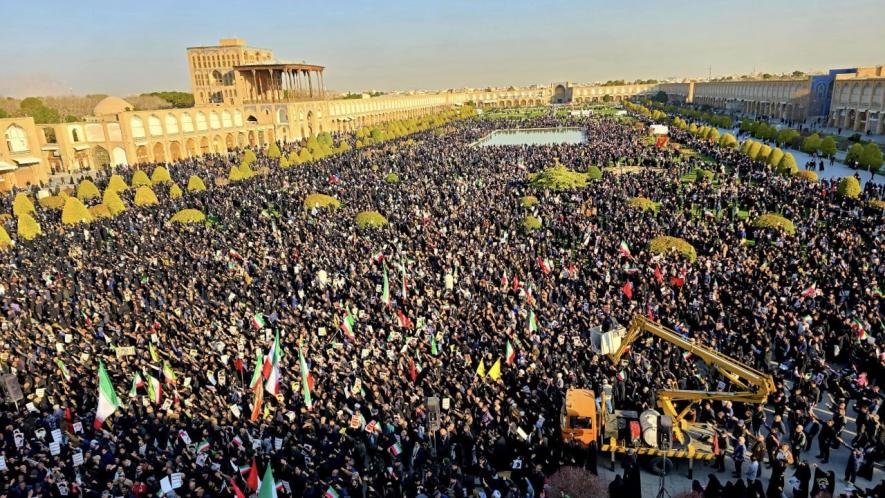
Crowds of mourners in Isfahan, Iran. Photo: Tasnim News
After bunker-buster bombs dropped by American bombers killed Iran’s Supreme Leader, Ayatollah Ali Khamenei, along with his 14-month-old granddaughter, close relatives, and high-ranking officials, the Iranian government declared him a “martyr” and announced 40 days of national mourning.
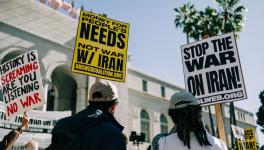
The incident drew mixed reactions globally. Some countries condemned it, while some others maintained silence or expressed support. However, in recent days, a strange trend is visible on the social media. After the news of Khamenei’s killing, some sections in India were more in celebration mode than mourning. The question arises—does celebrating the assassination of a foreign head of state reflect an expansion of our moral sensitivity, or its erosion? And was this happiness borne out of ideological disagreement, past hostility, some anti-national or anti-religious act, or simply because he was the leader of a Muslim country and himself a religious leader of the Muslim community?
In this context, there are certain uncomfortable questions that must be asked, because the issue is not about an individual, but about international law, sovereignty, and the soul of India’s foreign policy.
First Question: What Was Khamenei’s Crime?
If a military attack is carried out on the head of a sovereign and independent nation and is proudly justified as “targeted killing” or a “strategic strike,” then at the very least, the global community should be told what his crime was. Was he convicted by an international court? Did any recognised global institution authorise military action against him beyond sanctions?
According to the Charter of the United Nations, the use of force against a sovereign nation is legitimate only in self-defence or with the authorisation of the Security Council. An “extrajudicial killing” without any judicial process is a serious violation of international humanitarian law. If superpowers decide, bypassing these standards, who will live and who will die, then this will not be a rules-based order, but a power-based order.
Was Khamenei’s crime merely that he refused to kneel before US President Donald Trump? Can not being a friend of the United States of America, or exercising political independence, become a reason for bombing? If yes, then tomorrow any dissenting nation can be subjected to the same yardstick.
Second Question: Why India’s Silence?
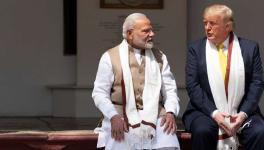
India has long described itself as a proponent of peace, non-violence, and morality. Prime Minister Narendra Modi has said on many platforms that “this is not an era of war.” But when the top leadership of a sovereign nation is killed in a bombing, what is India’s response? Can we not at least appeal for peace?
In diplomacy, words are chosen with great care. Sending condolences is not proof of policy endorsement, but a sign of human sensitivity. If we weigh every global event solely on the scale of our strategic equations, where will morality remain?
The history of India’s foreign policy has been based on non-alignment and strategic autonomy. But if our responses appear dependent on the approval of friendly nations, does that autonomy survive? It is noteworthy that Modi expressed concern for Israel and the UAE, and even innovated by tweeting in Hebrew to show additional affection toward Israel. But he could not issue even a single tweet of condolence on the killing of Iran’s Supreme Leader and religious head, even though a few years ago the Modi government not only sent condolences on the death of Iran’s President but also declared a day of national mourning.
Third Question: What About the Historic India-Iran Friendship?
It must be remembered that India-Iran relations are not based on one ideology or one government, but on centuries of cultural and strategic partnership. During the prime ministership of BJP’s Atal Bihari Vajpayee, significant agreements were signed between the two countries. In 2016, during his Tehran visit, Modi described India-Iran friendship as “centuries old.” India’s most friendly relations with Iran were during Khamenei’s tenure.
Even after India’s closeness with the US during Trump’s first term, Iran never opposed India. Despite being a Muslim country, Iran supported India in its diplomatic battles against Pakistan and often backed India at forums like the United Nations.
Another major symbolic example is the Chabahar Port. Despite pressure from China and Pakistan, Iran gave India a place in this strategic project, giving India an alternative route to Afghanistan and Central Asia. Despite US sanctions, Iran provided India concessions in energy supplies on several occasions.
Iran is among the few countries that trade with India in Indian rupees instead of dollars. Tens of thousands of crores of rupees belonging to Iran have remained deposited in Indian banks, improving the condition of some banks. In such a situation, if today the top leadership of that country is assassinated, should even India’s minimum emotional response be considered unnecessary?
Fourth Question: Today Them, Tomorrow Us?
History bears witness that the politics of “regime change” has destabilised many countries. In Iraq, based on allegations later widely regarded as unfounded, the US intervention of 2003 remains an example of regional instability. One must appreciate the firmness and clarity of former Prime Minister Manmohan Singh, who did not hesitate to call it US’s mistake even before foreign media.
The most recent example is ‘regime change’ in Venezuela. In Bangladesh, the American role was also behind the removal of India-friendly Sheikh Hasina. Trump has publicly embarrassed Modi dozens of times internationally—whether by claiming to have forced a ceasefire by threatening tariffs, boasting about Pakistan shooting down India’s Rafale aircraft, or claiming that he could remove Modi from power whenever he wished.
Trump’s attitude toward India has not been one of equality. If superpowers decide which governments are legitimate and which are not, it will create international anarchy. Indians—or citizens of any country—should not harbour the illusion that superpowers’ policies are based on permanent friendship. They choose friends and adversaries according to their national interest. If today someone else’s sovereignty is being attacked and we are clapping, who will stand up when our turn comes?
The Question of Individual vs Policy
It is necessary to clarify that disagreement with any leader’s policies is a democratic right. Criticism of Iran’s internal politics, human rights record, or regional policies is possible and should be. But there is a clear line between disagreement and assassination. If we erase this line, the moral foundation of international politics will collapse.
Those who enumerate the shortcomings of Khamenei’s rule must also answer: even if there were crimes, who gave the US the right to impose arbitrary punishment without judicial process? Is it a self-appointed international police officer?
Those who argue that Iran must be prevented from becoming nuclear-armed must also answer how many of its own nuclear weapons the US has reduced, or how many weapons it has reduced in stubborn nuclear-armed nations like North Korea. If Khamenei had wished he too could have knelt before Trump and remained Supreme Leader until his death by becoming a pawn in America’s oil geopolitics; he did not even have to contest elections every five years. He could have left Iran and sought asylum elsewhere. But when an 86-year-old head of state is killed in a bombing while remaining in office, attending meetings with his officials, and thinking of his country’s interest till his last moment, that image should at least compel us to reflect on the direction in which this style of power struggle is heading.
Khamenei may be remembered for a long time as an inspiring face in the struggle against US imperialism, but we must ask ourselves whether this is the kind of world order we wish for our coming generations.
Introspection for Indian Society
The most worrying aspect is the mindset that treats someone’s death as ideological victory. Has our civilisation—which proclaims “Vasudhaiva Kutumbakam” (the world is one family)—become so narrow that we view global violence through a communal lens? If the reason for happiness is merely that the deceased was “Muslim,” then it is a warning bell for our democratic and cultural values. Nationalism does not mean remaining silent on international injustice or turning it into celebration. True nationalism supports both our country’s autonomy and global peace.
With Whom Should We Stand?
The question is not about one individual. The question is whether we stand with power politics or with a rules-based order. Will we legitimise the tradition of imperialism, or insist on protecting international law and humanitarian values? Today, there is a need for India to clearly stand in favour of peace, sovereignty, and dialogue. Friendship and strategic partnership are important, but moral courage is even more important. Ultimately, celebrating any killing diminishes us from within. There may be disagreement, there may be criticism, but losing sensitivity toward human life is the defeat of civilization. History will judge the political legacy of Khamenei, but today Indian society must decide which value system it stands with—fear and bullying, or justice and peace.
The writer is a senior journalist, columnist, multidisciplinary cultural commentator and a research scholar in economics. The views are personal.
Get the latest reports & analysis with people's perspective on Protests, movements & deep analytical videos, discussions of the current affairs in your Telegram app. Subscribe to NewsClick's Telegram channel & get Real-Time updates on stories, as they get published on our website.