





Construction Workers: Trapped Under Blazing Sun, Rising Heat, Nothing to Fall Back on
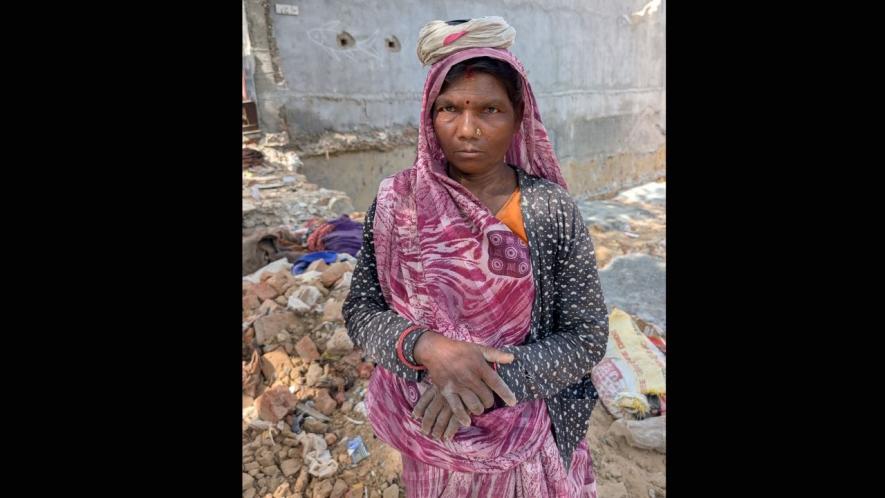
Prem Rani at the a construction site in Green Fields, Faridabad
Construction worker Prem Rani's sun-burnt wrinkled face and parched arms defy her real age. She is barely 45 years old but looks like a woman who has seen many more summers. Her friends Nirmala and Nagmani, who are about the same age, look no different.
These women workers from Simdega district of Jharkhand landed in Faridabad about 30 years ago. Seeing the tremendous growth of real estate, which offered plenty of job opportunities as daily wage labourers, they settled in the area around Surajkund and Badkal lake. Though not the same as the lush Sal forest of Simdega, the green cover of the arid Asola Bhati forest surrounding Surajkund did promise them shelter. Most of the buildings, houses and skyscrapers that have sprung up in the area in the last quarter century bear the invisible stamp of their hard work.
Like all other labourers, the day for Prem Rani, Nagmani and Nirmala starts at 4:30 a.m. when they enter the surrounding jungle to fetch wood and cook a meal for their family before preparing for the ordeal they will soon undergo.
Their quest for work begins at 7:30 a.m. when they start walking toward the Labour Chowk from their ramshackle huts in the Asola Bhati forest. A trot takes them a little more than an hour to reach the Labour Chowk near the gigantic towers where they must compete for the attention of prospective employers arriving in cars to pick labourers.
"We thank our God if we get work directly from the owner who is constructing a house. It means Rs 200-250 more than finding work through a contractor. Direct employment fetches us a daily wage of Rs. 700 a day whereas getting work through a contractor means Rs. 450-500 a day," says Prem Rani.
Today was a good day for Prem Rani and Nagmani but not for Nirmala.
At one o'clock in the afternoon, the sun blazed mercilessly, with the temperature soaring around 45 degrees Celsius. Nirmala decided to return home after finishing lunch with her friends, which consisted of curry with hardly any lentils, four rotis, a piece of onion and salt.
"It's my second day without work. I will try to arrive a bit earlier at the Labour Chowk tomorrow," Nirmala says with a wry smile that cannot camouflage her financial worries.
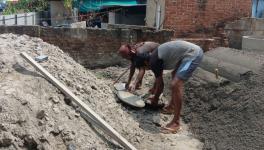
Nagmani and Prem Rani return to their worksite—a 12-foot-deep dug-up base of a 300-square-metre plot. Nagmani's job today is to break a heap of bricks and spread them evenly on two different patches. Prem Rani's work is carrying mortar mix from the roadside to the other end of the dug-up plot.
"It is very difficult to work in this heat. It seems hotter than last year. Look at my face, it's all burnt. But then what else can we do but this job. We often fall sick after three or four days of work but then try to find work again after two days of rest," says Nagmani. Her words resonate with the impact climate change is having on one of the most vulnerable sections: construction workers.
With narrowed eyes, she scans the road to see if the contractor has arrived. She risks being reprimanded for talking while working.
On average, construction workers manage to work 15 to a maximum of 20 days a month if they don't have an accident. Their monthly earnings range from Rs. 7,000 to 14,000.
"Some good employers and contractors provide us with potable water near the site but most don't. We bring our own water, but it doesn't last long in this heat. Fetching water is also a challenge at some sites as it is here," says Prem Rani, placing the broad iron pan containing mortar mix on her head. As she completes one trip in about four minutes, another pan weighing about 12 kg of mortar mix is ready to be picked up. This cycle continues unabated from 9 a.m. to 6 p.m. with a one-hour lunch break around one o'clock.
Women are usually chosen for this sort of work because they are focussed and shy, they also don't waste time smoking or rubbing khaini, says the contractor's aide, Santosh.
Nirmala started her journey back home. It's a tortuous 5-kilometre walk at 2 p.m. on the metalled road with negligible Kikar tree cover. A left turn onto the road heading toward Surajkund leads into the arid Asola Bhati forest, which is dotted with Kikar and Babool trees. About one kilometre inside the forest leads to a settlement of about 100 odd houses. Some have brick walls and thatched roofs, while others have only walls made of tarpaulin, wooden planks, and cardboard with thatched roofs.
Nirmala's 10x9-foot hut has brick walls and a thatched roof. She lives here with her husband, two children and her brother.
"There is electricity but it seldom comes. In any case, we have to use it sparingly because the local Gujjars charge Rs 320 per month for a bulb. We use it only to light a bulb at night before going to sleep. It is usually hot inside so we usually sleep outside in the summer. Nowadays even the nights are very hot," says Nirmala.
Her earthen pot has no water. She grabs two plastic buckets and starts a kilometre-long walk toward the temple. Four bucketfuls of water are all that a family of five needs for a day. Halfway to the temple, Nirmala's husband is sitting under a tree with three friends. After three days of hard labour, they decided to take a day off and wash their agony away with liquor. Nirmala cannot afford this luxury.
Nirmala’s neighbour Lalitha’s sunken face, hollow cheeks, thin limbs and laborious walk tell a sordid tale of how years of malnutrition and hard labour can rob a worker’s health and also hope.
Years of chronic malnutrition have given Lalita MRDM (Malnutrition-Related Diabetes Mellitus). It was discovered last year when an iron rod pierced her right foot above the bridge. The wound never healed. It was gangrene.
“The doctor said that my foot needs to be amputated. How will I get work after that? It’s better to die,” says Lalita.
Both her sons don’t want extra baggage. They take turns to give her a single meal every alternate day. For the second meal she depends on neighbours.
Anima Kandulna, president of Shehri Mahila Kamgar Sanstha, also runs a church and two free school in the basti. It serves more as a congregation place for women workers than a prayer room.
“It is getting difficult to make children study. Parenting is tough for mothers as they are the main earners. Children, especially boys, often pick up vices like liquor, drugs and gambling from their father. Mobile phones are another culprit,” says Anima.
Anita Kapoor, patron of Shehri Mahila Kamgaar Sanstha who has been trying to unionise these women construction workers for several years says their biggest problem is registration under the Building and Other Construction Workers (Regulation of Employment and Conditions of Service) Act, 1996.
"They have been living and working here for almost 30 years. But most workers here are not registered. This means they cannot get basic benefits -- health, insurance, or educational support for their children. They don’t receive financial aid when the government stops construction activity during excessive heat, they have nothing to rely on during an emergency," says Kapoor.
As per the BOCW Act, a 1-2% labour cess is levied on total construction costs to fund welfare measures for registered construction workers. Managed by state welfare boards, the fund is collected from employers to provide financial aid, health benefits, insurance, and educational support. Individuals building houses costing under ₹50 lakh are exempt.
Cumulative cess collections under the BOCW Act have reached ₹1,17,507.22 crore. Of this amount, the state welfare boards have utilised approximately ₹67,670 crore, according to the latest information. This has left a massive unspent balance of about ₹49,837 crore or ₹70,744.16 crore, if subsequent reports factoring in unallocated accrued funds are included.
The much-publicised state plans of the Haryana and Delhi governments regarding construction worker welfare measures during the heat wave seem far from reality.
Haryana's labour departments in districts like Faridabad, Hisar, Kaithal, Jind, Sirsa, and Bhiwani are in total disarray after state labour minister Anil Vij claimed on April 2 that nearly 90% of work slips examined during a probe into irregularities in the labour department were fake.
According to Vij, a Rs 1,500 crore scam was underway involving irregularities by the Haryana Building and Other Construction Workers Welfare Board.
Most labour welfare schemes were stopped and the Deputy Commissioners of all districts were directed to form district-level verification committees comprising a Labour Department officer and three other officials to find the fake workers. The investigation revealed that of 2,178,523 work slips examined, only 270,945 were valid, while 1,907,578 were identified as fraudulent. The re-registration process for construction workers is still underway and unless that is completed, there is little hope for the real construction workers.
Delhi government has prepared an ambitious plan to distribute special kits costing Rs. 1,890, containing sattu, ORS, sharbat syrup, prickly heat powder, gamcha, and other items for one lakh construction workers to help them cope with the intense summer heat. But so far it looks like a far cry as little evidence of this effort can be seen on the ground. It has also declared halting construction activities during four peak heat hours from 12 noon to 4 p.m.
"I have seen the Delhi government distributing gamchas and water at some places. But the government isn't compensating for halting the construction activity for four hours. This comes as a huge cost for construction workers in a scenario where inflation is hitting them every day because of the hike in fuel prices," says Abdul Shakeel, an activist working with construction workers.
Soumya Dutta, a trustee of MAUSAM (Movement for Advancing Understanding of Sustainability And Mutuality), an executive member of Friends of the Earth India, a former advisory board member of the UN Climate Technology Centre and Network, and a member of the national working group of National Alliance of People's Movements (NAPM) warns that construction workers are expected to undergo one of the harshest summers this year due to the Super El Nino impact.
"They work under direct sunlight on roads, open plots, metro lines and high-rise projects. They have to bear extremely high temperatures for long hours as climate change has raised baseline temperatures, while concrete expansion, traffic, waste burning and air conditioners help the city generate and trap heat.
These conditions directly threaten their survival and livelihood without basic necessities like access to shade, drinking water, cooling spaces, medical protection and the ability to stop working without losing income," says Dutta.
Meanwhile, oblivious to these threats, lakhs of unregistered women workers like Prem Rani, Nagmani and Nirmala brave the vagaries of nature every day -- from a torturous heatwave to piercing cold winds amid tough living conditions to earn two square meals. Workers like Lalita don't even have this opportunity.
The writer is a senior independent journalist based in Delhi.
Get the latest reports & analysis with people's perspective on Protests, movements & deep analytical videos, discussions of the current affairs in your Telegram app. Subscribe to NewsClick's Telegram channel & get Real-Time updates on stories, as they get published on our website.