





Odisha: ‘Days’ Reduced to Tokenism as Bhubaneswar Singes With 80-85 Humidity
On June 5, this reporter read a message from a school asking students to come to school with a pot or some container with a live plant tucked in. This was on the eve of World Environment Day on June 5.
It’s a shame that the school was trying to inculcate casual awareness for conservation of the environment with such trivially symbolic gestures toward the environment we live in.
Instead of instilling into the psyche of school students the paramount importance of nature during classes, asking them to get a pot with a plant was too myopic. The school could have chosen instead to introduce a period devoted to the practical environment before the eyes, which would have come in handy for learning.
Odisha’s environment exhibits a growing green cover alongside rising industrial pollution challenges. While state forest cover continues to expand, air quality in major mining hubs remains a concern. Meanwhile, water quality across primary river basins rarely meets safety standards.
“Although past records from the CABI Digital Library do not provide a specific number of isolated forest patches for Bhubaneswar in the early 1950s, because the area was not yet heavily fragmented. Instead, Bhubaneswar and its adjoining regions were characterised by one large, contiguous, and thick vegetation blanket, primarily known as the Rampur–Bharatpur Jungle”, says Biswajit Mohanty, an environmental activist, who heads the Wildlife Society of Odisha.
This dense jungle tract was an integrated part of the larger Chandaka–Damapara forest complex. When German architect Otto Königsberger began designing the new capital city following its foundation in 1948, the master plan initially carved out just 510 hectares of land from this vast, continuous ecosystem
“The landscape for the new capital featured massive, uninterrupted stretches of semi-evergreen and moist deciduous flora rather than a cluster of broken patches” recounts Mohanty, adding that, “records indicate that it was a kind of paradise offering a forest cover that was so dense and intact that early government officials resisted moving from Cuttack to Bhubaneswar out of a fear of wild animals”.
Imminent End
Leaving aside Bhubaneswar’s core areas, such as the Assembly, the Secretariat, the Accountant General ‘s Office, Raj Bhavan onward, stretching to official residences and hospitals, the race did not stop there.
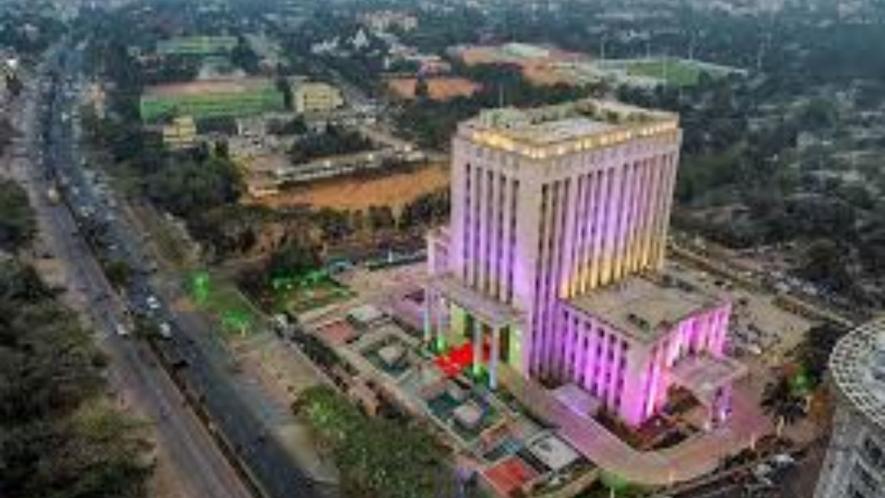
Expansion and felling of trees and remnant foliage, including century-old roadside trees for road expansion became common. Human habitations inside the main capital appear pitiably chipped when seen from the sky. The balance is few and far between.
Bhubaneswar’s urban landscape is a striking mix of planned greenery and rapid vertical construction. Recognised for its green boulevards, the city boasts an average population density of around 4,500 to 7,300 per sq. km, but shifting land-use patterns have drastically reduced its overall vegetation cover to roughly 6–11%
Then the process of fragmentation was so rapid that it slowly consumed the Bharatpur Forest block or a symbolic Ekamra Kanan and worse, and even the closely adjoining areas of the Chandaka Elephant Sanctuary, making room for institutional buildings, housing complexes that began intersecting the century-old original jungle.
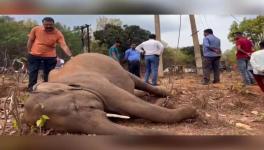
In its fall-out, fragmented animal corridors posed a threat to 72 elephants of Chandaka sanctuary.
In that situation, the survival of animals, like the pachyderms who travel miles and miles in a day through corridors, stray into danger zones. Many never came back to the sanctuary, where diminishing foliage and reducing water sources are a critical deterrent for their homing instinct. No wonder, the Chandaka Elephant sanctuary is without an elephant.
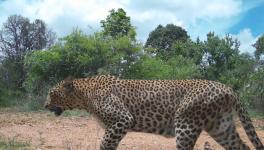
As on date, the expanses from the National Highway to as far as Ghatikia and beyond, spring nostalgic surprises such as the frequent movement of monitor lizards, fox, jackals, mongoose and snakes, but sadly, most of them suffer death due to vehicular traffic.
Why do They Wander
Where else do these wildlife go? Down town toward North of Bhubaneswar, some vast areas were given to private housing and schools like DAV, Kendriya Vidyalaya (5), and what is left is just inimical to the wildlife stock that have become aliens in their own home.
Today, Odisha’s capital city Bhubaneswar has been reduced to simply a hot and gaseous landscape.
The writer is a freelance journalist based in Bhubaneswar, with over 40 years’ experience in the profession.
Get the latest reports & analysis with people's perspective on Protests, movements & deep analytical videos, discussions of the current affairs in your Telegram app. Subscribe to NewsClick's Telegram channel & get Real-Time updates on stories, as they get published on our website.