





Political Economy of US Supreme Court Nixing Trump Tariffs
Image Courtesy: Rawpixel
The US Supreme Court’s two-thirds majority ruling, which declared President Donald Trump’s 2025 global tariffs illegal, has been widely framed in mainstream discourse as a constitutional check on executive overreach – that is, an institutional self-correction.
While the legal details regarding the misuse of the 1977 International Emergency Economic Powers Act (IEEPA) are significant, a deeper political-economic process is at play. The invalidation of the Trump tariffs is a tacit admission by US monopoly capital that the United States is not strategically capable of winning a multi-front trade war. This strategic incapability underlies the fact that the macroeconomic burden of this trade protectionism has been overwhelmingly domestic, falling on non-monopoly capital and working people.
The legal rationale provided by the US Supreme Court majority decision is that the authority to levy taxes and tariffs rests exclusively with the US Congress during peacetime. By invoking the major questions doctrine, the US Supreme Court nullified the Trump administration's attempt to seize decision-making power over economic policy from ambiguous language in a statute designed for national emergencies.
However, to interpret this defeat for the Trump administration solely as a victory for US constitutional laws and norms would involve ignoring the material conditions in international political economy that underlie the US Supreme Court decision.
Failed Trade War
The Trump tariff war that began in 2025 was not merely a legal misstep; it was an economic miscalculation based on a non-sober assessment of US strategic capability in international political economy.
It is therefore unsurprising that many studies have confirmed that the incidence of the Trump tariffs fell almost entirely upon US entities, especially non-monopoly capital and working people. One study indicates that for most of 2025, approximately 94 per cent of the tariff cost was borne by "US importers and consumers" through the near-complete pass-through of higher tariffs into higher prices. Foreign exporters, rather than lowering their prices to absorb the Trump tariffs, appear to have maintained their export prices, effectively compelling US entities to pay the tariffs. This amounts to a ringing refutation of the Trump administration’s claim that tariffs are a tax on foreigners. In other words, the power of US capital to dictate terms to foreign suppliers proved surprisingly weak. US monopoly capital was, however, able to transfer this burden to US non-monopoly capital and working people in the US. The contractionary effects on macroeconomic demand of this burden transfer have been partially mitigated until now by the artificial intelligence boom-induced investment. The recognition of the unsustainability of the artificial intelligence boom and its end will decisively undermine US macroeconomic demand and enhance strategic weakness.
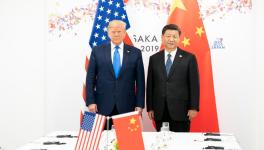
This strategic weakness is contextualised by the Trump trade war’s primary target, namely China. By the end of 2025, China’s share of US non-oil imports had fallen sharply. Yet, the underlying trend involves not a resurgence of US production, but the rise of countries such as Mexico and Vietnam, through which Chinese exports reached the US involving various levels of further value addition.
The Chinese government was able to exercise adequate leverage to compel the Trump administration to retreat. In response, the Trump administration tried to unleash a predatory trade offensive against other countries with two objectives. First, compelling these countries to become destinations for US exports at prices favourable to US monopoly capital. Second, attempting to coerce these countries into being part of the US government effort to economically isolate China.
However, the Trump administration’s goal of economically isolating Beijing failed, resulting instead in the relative isolation of the US economy from the Chinese economy.
Burden on Working People
The inelastic nature of many US imports has meant that higher post-tariff prices widened the current account deficit. Therefore, US entities paid more for possibly fewer goods. While tariff revenue of the US government increased, the use of this tariff revenue to try to reduce the fiscal deficit of the US government imparted a further contractionary impulse to macroeconomic demand. This is the case since such import tariffs, along with the aforementioned tariff burden shifting by US monopoly capital towards non-monopoly capital and especially working people, amount mostly to a tax on wage incomes, which will be contractionary if the resulting tax (tariff) revenue is not spent. Even if the tariff revenue were fully spent by the US government, that would merely leave macroeconomic demand unchanged.
If Trump's trade war had succeeded, then there would have been no credible legal or other types of challenges to Trump's executive overreach. But Trump's trade war has failed. The recognition of this failure aligns with the court’s implicit recognition that the executive’s policy was not just procedurally flawed but substantively damaging to US capital.
The composition of the US Supreme Court majority is particularly telling in this respect. Two Trump-appointed US Supreme Court judges joined the liberal bloc to strike down Trump's tariffs. This demonstrates that when the broader interests of US capital are at stake, even many conservative judges or officials will operate to try to defend these broader interests.
US monopoly capital has likely arrived at the realisation that launching a trade war without a decisive strategic advantage merely raises costs for US monopoly capital and invites retaliation from rival powers, especially China. This has ended up exposing the fragilities of US imperialism.
The dissenting judges in the US Supreme Court have warned of a ‘messy’ refund process for the tariff revenue collected by the US government and have also noted that the ruling does not prevent the use of other statutory provisions by the US President. Following this lead, Trump has imposed a 15 per cent across-the-board tariff on imports from all countries but there are important challenges in international political economy that make any restarting by the US government of a full-fledged trade war inadvisable.
Why did Trump launch the trade war in the first place? As long as the US dollar's status as the international reserve currency was secure, the US current account deficit could be financed at almost any rate of interest offered on US government securities. However, the attenuation of the strategic heft of the US government due to the rise of China and the return of Russia, and most significantly the strategic concord between China and Russia, has undermined the confidence of international capital in the ability of the US government to fully secure the status of the US dollar as the international reserve currency. Therefore, the current account deficit of the US economy, the Trump administration reasoned, had to be managed partly by external borrowing as before and partly by increasing US exports to the rest of the world, which motivated the trade war.
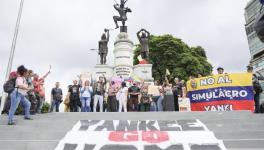
The failure of the trade war demonstrates that the strategic array of forces in international political economy, which is relatively unfavourable to US imperialism, cannot be overcome by infeasible actions such as the imposition of US tariffs. That is why there is a mainstream media blitz about the self-correction of US institutions, which thereby seeks to draw (albeit vainly) an ideological veil over the declining strategic heft of US imperialism. The recent predatory moves of the US government against Venezuela, Cuba, Iran, Nigeria, etc. are partly another way to draw a military veil over the aforementioned declining strategic heft of US imperialism.
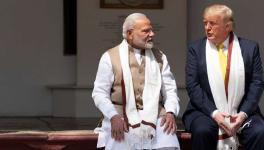
It is therefore high time that governments such as India’s immediately put their unequal trade agreements with the US government on hold and actively diversify their international trade and financial relations away from the US by emphasising South-South cooperation in both the economic and security domains.
C. Saratchand is Professor, Department of Economics, Satyawati College, University of Delhi.
Get the latest reports & analysis with people's perspective on Protests, movements & deep analytical videos, discussions of the current affairs in your Telegram app. Subscribe to NewsClick's Telegram channel & get Real-Time updates on stories, as they get published on our website.