





Repeated Events in History as Farce: US-Israel War Against Iran
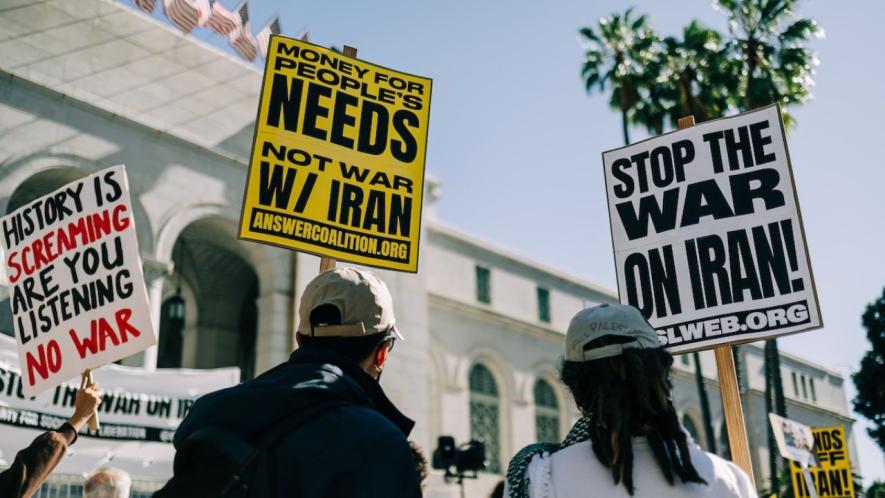
Rally against the war on Iran in Los Angeles. Photo: PSL LA
The opening lines of one of Karl Marx’s works (Eighteenth Brumaire of Louis Bonaparte) begin with his mention of Hegel, who said that major events of history repeat. Marx comments that Hegel forgot to add that first they occur as tragedy and second as farce. We do not know whether both the observations, namely ‘major events repeating’ and ‘occurring as tragedy first and then repeating as farce’ could be held valid in human history across time and space.
Social scientists have always shown ambivalence toward any generalisation that could hold always true. If we accept this law, then human subjectivity and its role in shaping individual and collective processes ceases to exist and society and events become identical with the natural phenomena. However, social sciences have been struggling to work out general principals of social processes for more than a century. Anything they have been able to come up is that all societies are characterised by an endeavour to have harmony and consensus of values as well as existence of conflict. Despite all these limitations there are historical occasions when events repeat with identical consequences to what Marx had commented in the middle of 19th century. Let us take the most recent one.
When Israel attacked Iran in June 2025 and Iran responded with an equal ferocity, the US intervened by bombarding the nuclear facilities without effect, but the US-intervention ended the conflict by declaring that it had destroyed Iran’s nuclear capability. Then began various rounds of negotiations between Iran and the US.
In the beginning of 2026, the world came to learn that there were anti-government demonstrations in Iran and various news agencies reported that the Islamic Republic suppressed the movement ruthlessly by killing more than 30,000 people. As a matter of fact, the propaganda against the Islamic Republic of Iran never stopped in the Western media.
On February 28, 2026, the US-Israel attacked Iran killing a large number of people that included the head of the state, Ayatollah Ali Khomeini, along with his family as well as some top leaders of note, and about 170 school girls. The Western press showed its tremendous consistency by keeping quiet on the killing of school children as it had already done when Israeli attack had been killing children in Gaza and later on Southern Lebanon.
The Iranian response to these attacks were measured, consistent, effective and well planned. The entire world was expecting the Iranian collapse that never happened. While working out the reason for Iranian ability to resist, the argument offered was that Russia and China had been helping the country in various ways.
Upon further explorations, it dawned on the world that Iranian society had developed in terms of education, technology and innovations. Women were highly educated and were engaged in various professional activities thus demolishing the myth of the oppressive nature of the Iranian political system.
It is generally understood that unlike the democratic system of governance, the totalitarian regimes are ruled by dictators resulting in a situation where the identities of political system and the dictator become synonymous. The disappearance of the dictator leads to the collapse of the regime, for it is assumed that the people in general had been suffering from the oppressive nature of the regime and seek to change it.
This is exactly what the US-Israel were expecting, but it did not happen. What emerged was that the political system of Iran has been highly institutionalised in addition to which it was not oppressive the way the people of the world were made to believe. In fact, the education levels of Iranian ministers surprised the rest of the world.
On top of that, it became clear that if the people of Iran in general were unhappy with their government, then it never meant that they would turn against it at the time of crisis. Iranians showed unwavering unity and will to fight against the aggressors. They united forgetting their economic challenges that had been largely the results of sanctions against their country imposed by the US since 1980s. The appeal of Donald Trump, the US President, to the people of Iran to take over the Iranian government turned into a farce.
It was not the first time in history that a country was invaded with the assumption that the local people would join the invaders, because they were unhappy with their rulers. One is reminded of World War II when in 1941, the Nazi Germany invaded Soviet Union under Hitler. It has remained the biggest ground attack in the history of the world.
William L. Shirer, the author of The Rise and Fall of Third Reich, writes by referring to the German General Kliest, who told in an interview that “Hopes of victory were built on the prospect that the invasion would produce a political upheaval in Russia” (p. 855). And then Shirer (p. 856) informs us that Hitler had told another army general, Jodl, “We have only to kick in the door and the whole rotten structure will come crashing down”.
The history of the World War II informs us that Nazi Germany’s decline began when the German forces had to retreat and the Soviet troops stopped only when they entered Berlin and the Allies’ armies captured the rest of the capital. The magnitude of the tragedy of Soviet-German war can be measured by the number of lives of lost which were in millions and added by the destruction it caused.
Loss of lives is the greatest tragedy in any war, but nations have not learnt any lesson from history. Assuming that a nation of 90 million people would just surrender because people do not like the regime, is nothing short of farce. ‘People’ as a conceptual category is highly ambiguous because it hides certain socio-political heterogeneity by assuming that it is comprised by homogeneous population. However, there is no guarantee that the aggressors will learn from this war in future.
The writer was a professor of sociology at the Guru Nanak Dev University, Amritsar, and former president of the Indian Sociological Society. The views are personal.
Get the latest reports & analysis with people's perspective on Protests, movements & deep analytical videos, discussions of the current affairs in your Telegram app. Subscribe to NewsClick's Telegram channel & get Real-Time updates on stories, as they get published on our website.