





Somnath Temple: History as Political Tool, Yet Again
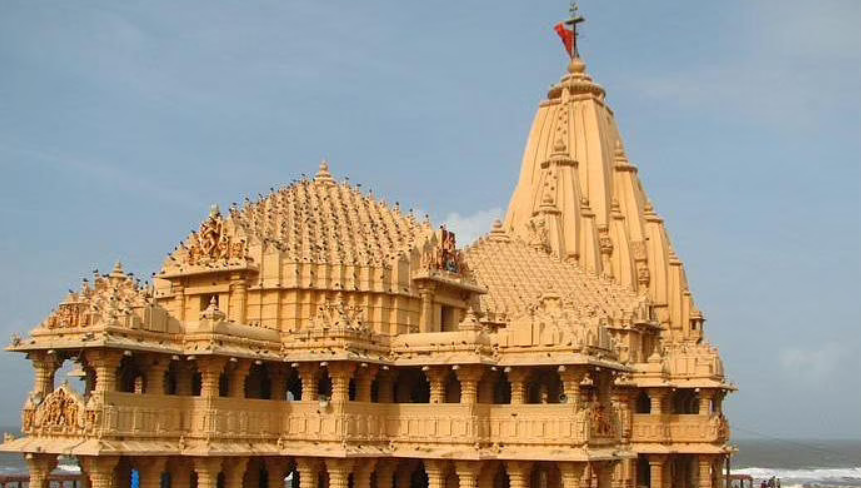
Representational use only.
The campaign around the Ram Temple, i.e. demolition of the Babri Masjid; paid rich electoral dividends to the Bharatiya Janata Party (BJP) and also to its parent, the Rashtriya Swayamsevak Sangh or RSS. Kashi and Mathura are now in the line.
A new front has now been opened with Somnath Swabhiman Parv (Somnath Self Pride Festival)… Speaking on the occasion with full religious regalia, our ‘non-biological’ Prime Minister stated two things, directly and subtly. One, that as the Somnath Temple stood as the symbol of the glory of India, the Muslim kings attacked it repeatedly, but it kept coming back in greater glory. Mahmood Ghazni demolished it in 1026 and plundered it 17 times.
The second point the Prime Minister made was directed against Congress party and more particularly, the country’s first Prime Minister Jawaharlal Nehru, the present Prime Minister’ pet hate persona, as being opposed to its rebuilding.
It is doubtful if any place of worship can be the ‘symbol’ of any nation. The most important part of religion has been its moral values, as the Father of the Nation, Gandhi, taught us. As far as Ghazni is concerned, he did plunder the Somnath Temple. His court historians highlighted that he did it for religious purposes, as idol worship is not permitted in Islam. Persian sources Al-Utabi and Al-Baruni, term Somath Temple as a treasure house. In this theory, the major loophole is that if idol destruction was his aim, why did he spare so many idols that were on the way from Gazna to Somnath?
Ghazni might have had many motives behind the raid on Somnath. The primary was wealth; it was among the rich temples of India. As per, historian Romila Thapar (History of Ancient India, Penguin), it had wealth equivalent to 20,000 golden dinars (coins) There are no definitive sources that Gahzni plundered it 17 times. This is a popular myth. The wealth he plundered was loaded on many elephants and taken to Gazna. His army had many Hindu generals, like Tilak, Sondhi, Harzan and Hind, as per Tarikhe Bayaki. Mahmood’s successor Masood sent his army under the leadership of Tilak, one of the generals of his army, to Central Asia to plunder wealth from a mosque.
Ghazni appointed one of the local Hindu kings as his governor as he left Somnath. He also issued coins with Sanskrit words on them. More so, King Anandpal of Thaneshwar helped him by sending him elephants and soldiers etc.
Temple destructions in ancient India and medieval India were not primarily a religious phenomenon. American historian Richard Eaton, in his research on temple destructions in pre–Mughal India, tells us that in a fight between two Hindu kings, the victor used to demolish the Kuldevata (clan god) idol of the defeated king and install his own Kuldevata there. In the fight between Khilji and Abdul Fath Dawood of Multan, a masjid was destroyed.
Associating religion with the Kings began with the British colonists who introduced communal historiography in India to pursue the policy of ‘divide and rule’. Beginning with James Mill’s book on History of India to Elliot and Dawsons’ multivolume, History of India as told by her Historians, religion was the central marker of a King's rule.
Read Also: Taliban & Hindutva Patriarchy: What’s Similar, What’s Different
Prime Minister Narendra Modi’s politics is opening this new divisive front and trying to tie in Nehru in the narrative. He is projecting as if Nehru was opposed to rebuilding of Somnath Temple. That’s a lie.
The matter came up when Gandhi was alive and he categorically stated that State funds should not be used for the building of the temple. This is what the Supreme Court a few years ago opined when the Ram Temple was being planned. Gandhi, Nehru and Sardar Patel were unanimous on this. In a prayer meeting on November 28, 1947, Gandhi states that Junagadh government cannot give any State funds for building of the temple.
Gandhi asked Patel whether any funds were being given to the building of Somnath Temple. Patel replied that “till I am alive, no such thing will happen” and that donations for rebuilding will be collected from the public.
As per this, a trust was formed with Patel as Chairman and K.M. Munshi and V.N Gadgil as trustees, which completed the task of building the temple.
The false propaganda does not stop here. Then comes the inauguration of the temple. President Rajendra Prasad was invited to inaugurate the temple and asked Nehru about it. In a letter to Nehru on March 2, 1951 addressed to Nehru, he said that he wanted to go to inaugurate the temple in his personal capacity. Nehru said if he wanted to go, he had no objection. The same thing Nehru said to C. Rajagopalachari on March 11, 1951. (As per author Piyush Babele)
Babele clarifies the whole truth based on evidence. He also takes a dig at the present Prime Minister, as to why the then President Ramnath Kovind and ccurrent President Droupadi Murmu were not invited in the events related to the Ram Temple. Clearly, these two Presidents were not invited for the Ram Temple foundation event and inauguration, as one is a Dalit and the other an Adivasi!
In a supplementary on history, Ajit Doval, who has been holding the high post of National Security Advisor, on the occasion of the inauguration of a youth festival in Delhi, gave advice that is very retrograde. As per him, “our temples were plundered, our villages were ransacked” so it is time now to “take revenge for this!
The question is whether revenge is part of the modern legal system. It is stuff from the medieval times. For every crime, the guilty should be punished and the innocent should be given protection. So, for the alleged crimes, Doval is asking for revenge is to be taken, but against whom? For temple destruction by Muslim and Hindu kings, who should be taken revenge on?
There are atrocities of history that Doval did not mention. The Buddha Vihars were destroyed, Jain temples were smashed, atrocities against Dalits and women were the norm. There was the tradition of Sati, burning women alive on the funeral pyre of her husband. Against whom should revenge for all this be taken?
History is not a tool to divide the society and perpetuate the injustices of the past. It is there to show us what wrongs have happened in the past, which should not happen again. We need to march toward a just society where all live the life of dignity and respect. A society where all of us enjoy equal citizenship rights.
The writer is a human rights activist, who taught at IIT Bombay. The views are personal.
Get the latest reports & analysis with people's perspective on Protests, movements & deep analytical videos, discussions of the current affairs in your Telegram app. Subscribe to NewsClick's Telegram channel & get Real-Time updates on stories, as they get published on our website.