





Structural Collapse of Nuance in Indian TV News

Newsclick Image by Nitesh Kumar
As per BBC’s media profile of India, nearly 900 private satellite television stations are currently on air across the country, with roughly half devoted to news and current affairs, reaching approximately 197 million TV homes. By any measure, this is one of the largest and most densely saturated television news ecosystems in the world. That scale was long considered a democratic achievement: evidence of a vigorous, plural media landscape capable of holding power to account across languages, regions, and communities.
Examined more closely, however, the abundance of channels has produced a paradox. More debate has generated less clarity. The saturation of television airwaves has coincided not with a deepening of public understanding but with a steady erosion of the very conditions that make informed democratic debate possible.
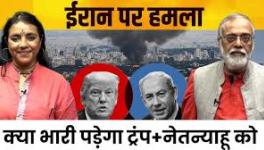
The primetime news debate is the defining genre of Indian broadcast journalism. It is also one of the least suitable formats for the kind of information citizens actually need. Anchors interrupt before arguments are fully formed. Guests are selected for their ideological predictability rather than their expertise. The format rewards confident assertion over careful qualification, emotional escalation over informational clarity, and competitive nationalism over factual analysis. The result is television that generates enormous heat while producing very little light.
The Business Model of Outrage
This trajectory has a traceable history. The structural conditions for the present crisis were set in motion by the post-liberalisation opening of the 1990s, when private satellite television expanded rapidly in an environment of minimal regulatory oversight and intense competition for advertising revenue.
The pace of deterioration accelerated sharply after 2014, as the political environment became less tolerant of adversarial journalism and economic pressures on newsrooms intensified simultaneously. What began as a market-driven distortion of journalistic norms has, over three decades, hardened into the structural condition of Indian broadcast news.
Understanding how this happened requires looking beyond the studios. The transformation of Indian television news is inseparable from its business model. Reported journalism is expensive: it requires correspondents, field access, editorial verification, and time. Studio debates, by contrast, are comparatively cheap. A single anchor, a set, and a group of remotely connected panellists can fill hours of airtime at minimal cost.
In a highly competitive ratings environment, funded almost entirely by advertising, the economic logic of outrage became self-reinforcing. Sensationalism works in the short term. It generates clicks, shares, and viewing minutes. It is, over time, deeply corrosive of the public trust that gives journalism its value.
The shift from field reporting to studio outrage has deeper roots than the political environment of the last decade alone. Nalin Mehta’s (2008) foundational account of Indian satellite television’s rise documented how the ratings war of the 1990s and 2000s progressively restructured news around what producers believed audiences wanted rather than what they needed. The format logic that emerged from that competition, with its short panels, high-decibel disagreement, and spectacular visuals over substantive information, bears close resemblance to what Daya Kishan Thussu (2007) identified as the global rise of infotainment: the systematic subordination of informational value to entertainment value across broadcast news internationally. India did not merely adopt this tendency; it intensified it, in a market where regulatory pressure was low, competition extreme, and the distance between political power and media ownership was shrinking.
This structural drift was not accidental. The rise of the studio debate coincided with a broader hollowing out of field reporting across Indian television. As the presence of correspondents on the ground diminished, the studio anchor became the arbiter not just of tone but of fact. The question of who had broken a story, and how, was gradually displaced by the question of who could shout about it most effectively.
Who Owns the News
The credibility crisis cannot be separated from the question of who owns Indian media. Most major television networks are embedded within large corporate conglomerates whose business interests extend far beyond journalism into infrastructure, telecommunications, real estate, and finance. These sectors depend heavily on their regulatory relationships with the government.
As Reporters Without Borders (RSF)’s Media Ownership Monitor has documented, India lacks specific laws or regulations on cross-media ownership concentration, leaving the field open for powerful conglomerates to accumulate influence without meaningful structural oversight. Reliance Industries’ control over the Network18 group and the Adani Group’s acquisition of a majority stake in NDTV in 2022 are among the most consequential recent examples of this trend.
The editorial consequences of such concentration are not always dramatic or visible. Overt censorship is the exception rather than the rule. More often, the effect is visible through omission, selective emphasis, and the quiet disappearance of stories that might threaten the political or business interests of owners.
Certain subjects receive disproportionate airtime precisely because they generate emotional engagement without threatening institutional power. Others simply do not get covered. As Vinod K. Jose observed in an influential essay for The Caravan, Indian media lacks a coherent guiding philosophy that might help it resist the combined pressures of political proximity and commercial capture, making it, in his words, the country’s most vulnerable institution.
The relationship between media ownership and political alignment in India maps closely onto what Daniel Hallin and Paolo Mancini (2004) described as “political parallelism” in their comparative framework for understanding media systems: the structural alignment of media organisations not merely with reporting on political life but with particular political projects.
In the Indian context, this alignment is driven less by party affiliation in the European tradition and more by the convergence of corporate interest and state regulatory power. Owners who depend on government licences, infrastructure contracts, and credit from state-aligned financial institutions have structural reasons to avoid editorial positions that threaten those relationships. The resulting self-censorship rarely presents itself as censorship; it presents itself as editorial judgement, moderation, and balance. The consequence, as Hallin and Mancini’s framework would predict, is a media landscape in which independence is claimed but structurally improbable.
Failure Under Pressure
The consequences of these structural problems become most acute precisely during moments of national crisis. During the India-Pakistan tensions of May 2025, Indian mainstream television channels were criticised by fact-checkers and media professionals for flooding the public with sensationalist coverage, doctored visuals, and disinformation at a critical geopolitical moment. The episode was widely described as a national embarrassment that actively misled citizens when accurate information mattered most.
The same dynamic played out on the international stage. A widely discussed panel on the Piers Morgan programme, designed to debate the ceasefire between India and Pakistan, drew widespread criticism for devolving into competitive nationalist point-scoring and repeated interruptions, with guests attempting to raise questions of international law consistently sidelined. The episode illustrated a lesson that applies equally to Indian domestic television: debate formats structured around conflict tend to produce theatrical exchange regardless of the actual stakes involved.
A distinct but related problem has emerged from within the profession itself. A generation of Indian reporters that built careers on cultivating confidential sources, and the accountability journalism such sources made possible, has progressively moved away from that practice.
As Al Jazeera’s journalism review has documented, this reflects growing caution among journalists navigating an increasingly hostile legal environment, but it also marks a significant reduction in the investigative capacity of the press at the moment when that capacity is most needed.
What the Data Shows
These patterns are now reflected in formal assessments of India’s media environment. India fell to 157th place out of 180 countries in the 2026 World Press Freedom Index published by Reporters Without Borders, a six-place drop from the previous year.
The index cited highly concentrated media ownership, outlets with increasingly overt political alignment, and a growing use of national security and criminal defamation laws to judicially harass journalists. India now ranks below all of its immediate South Asian neighbours except China, a comparison worth pausing on for a country that describes itself as the world’s largest democracy.
The legal environment surrounding journalists has deteriorated in measurable ways that extend beyond rankings. The Committee to Protect Journalists has documented a sustained pattern of India’s authorities deploying sedition provisions, the Unlawful Activities (Prevention) Act, and criminal defamation statutes against working journalists and editors, producing a chilling effect that extends well beyond those directly prosecuted.
The Editors Guild of India has repeatedly warned that this legal architecture, in combination with the dependence of media houses on government advertising revenue, generates structural compliance that no explicit editorial instruction needs to be issued to maintain.
The cumulative result is an information environment in which the most consequential stories, those involving the exercise of State power, are precisely the ones least likely to be pursued with the rigour that democratic accountability demands.
Trust data tells a similarly complicated story. The Reuters Institute’s Digital News Report found that while overall trust in news among English-speaking, digitally connected Indians surveyed stood at 41% in 2024, partisan commercial broadcasters, whether extremely critical or extremely uncritical of those in power, attracted active distrust among respondents.
Legacy print titles and public broadcasters fared significantly better on credibility measures, suggesting that the crisis of trust is not uniform but concentrated precisely in the kind of television news that dominates primetime across the country.
These pressures are not confined to English-language media. Hindi and regional-language television channels frequently operate in even more aggressive competitive environments while simultaneously reaching far larger audiences. In Telugu and Kannada media markets, for instance, the combination of intense channel proliferation and hyper-local political patronage has produced news ecosystems where the boundary between journalism and electoral campaigning is especially porous.
The structural dynamics of regional television also intersect with patterns that Robin Jeffrey (2000) identified in his account of the Indian print media’s expansion: that growth into vernacular media markets frequently produces journalism more deeply embedded in local patronage networks than its national, English-language counterparts.
In the television context, the consequences are amplified by speed and reach. A regional-language news channel can shape electoral perception across an entire state within hours, in an environment where independent fact-checking operations working in those languages remain scarce and regulatory oversight no more robust than at the national level.
Regional audiences, who often have fewer alternative information sources than their urban, English-speaking counterparts, bear a disproportionate share of the democratic cost of sensationalist formats. The effects of this structural dysfunction, therefore, extend well beyond the English-speaking minority that typically features in media commentary, reaching deeply into India’s broader democratic culture.
Limits of the Digital Alternative
The decline in trust in broadcast journalism has produced a predictable response: growing disengagement from television news, and migration toward independent digital platforms. Such platforms have produced genuinely important investigative work over the past decade. Yet they remain financially fragile and concentrated in reach among educated, urban, digitally connected audiences. Television, despite its credibility problems, continues to shape mass public perception in ways that digital journalism has not yet been able to match or replace.
There is also a structural irony in the digital turn. Many independent journalists who migrated to YouTube and other platforms to escape editorial interference have found themselves facing a different kind of vulnerability. As Raksha Kumar (2024) has documented, several such channels have faced blocking orders, demonetisation, and algorithmic suppression, suggesting that the digital space is not the neutral refuge it once appeared to be.
The conditions that distort broadcast journalism, including political pressure, regulatory uncertainty, and financial precarity, are increasingly migrating to digital platforms as well, compressing the already limited space for independent, public-interest journalism in India.
The democratic problem is, therefore, not resolved by pointing to the existence of alternatives. It lies in the erosion of shared information landscapes: the common frameworks of verified, accountable journalism that allow citizens across geographic and social divides to reason together about collective life. When those frameworks weaken, what fills the space is not pluralism but fragmentation, disinformation, and a cynical withdrawal from public life that democratic governance cannot afford.
Where to Go from Here
There are no simple solutions, but the direction of necessary change is reasonably clear. Media ownership regulation requires serious public attention. The absence of cross-ownership rules and the lack of transparency in ownership structures are not merely technical regulatory failures. The institutional architecture for such regulation is, at present, conspicuously inadequate. The Press Council of India has jurisdiction only over print media and holds no authority over television. The Telecom Regulatory Authority of India (TRAI) governs distribution and carriage but not editorial content. No regulatory entity currently exercises oversight over the editorial practices or ownership structures of television news stations.
Closing this regulatory vacuum, whether through expanding the Press Council’s mandate, creating a new statutory body for broadcast journalism, or legislating transparent ownership disclosure requirements, requires political will that has thus far been absent, but naming the gap precisely is a necessary first step.
These are political choices with democratic consequences, and need to be debated as such. The profession itself must recover the value of field-based, source-driven reporting over studio confrontation. The decline of ground reporting has weakened journalism’s capacity to represent the social complexity that democratic governance actually requires, and restoring it will demand both investment and editorial will.
Journalism education must also reassert the centrality of ethics, verification, and careful listening alongside the technical skills of production. Speed has progressively overwhelmed reflection across much of Indian television journalism. The consequences are visible not just in factual errors but in a broader thinning of the interpretive frameworks that journalists bring to complex stories. Reporters who have never been trained to read a court judgment, interpret an economic data release, or situate a policy decision within its legislative history are poorly equipped to do the work that democratic accountability requires.
Restoring that capacity is not simply a matter of adding ethics modules to existing curricula. It requires a fundamental reorientation of what journalism education considers its core purpose: away from speed and predemands. Reversing that balance is a long-term task that begins in how the next generation of journalists is trained.
The crisis of Indian television news is, in the end, a democratic crisis. When the institutions responsible for informing citizens lose credibility, societies lose their capacity for shared public reasoning. Democracies do not erode solely through authoritarian laws or the capture of courts and bureaucracies. They also erode, more quietly, when noise systematically overwhelms the possibility of understanding.
Dr. Neeraj Bunkar is a researcher specialising in caste and cinema. Dr. Aniruddha Jena teaches at the Indian Institute of Technology, Mandi, and is a Charles Wallace India Trust Visiting Fellow at King’s College London. The views are personal.
Get the latest reports & analysis with people's perspective on Protests, movements & deep analytical videos, discussions of the current affairs in your Telegram app. Subscribe to NewsClick's Telegram channel & get Real-Time updates on stories, as they get published on our website.