






What Happened in Kamla Mills?
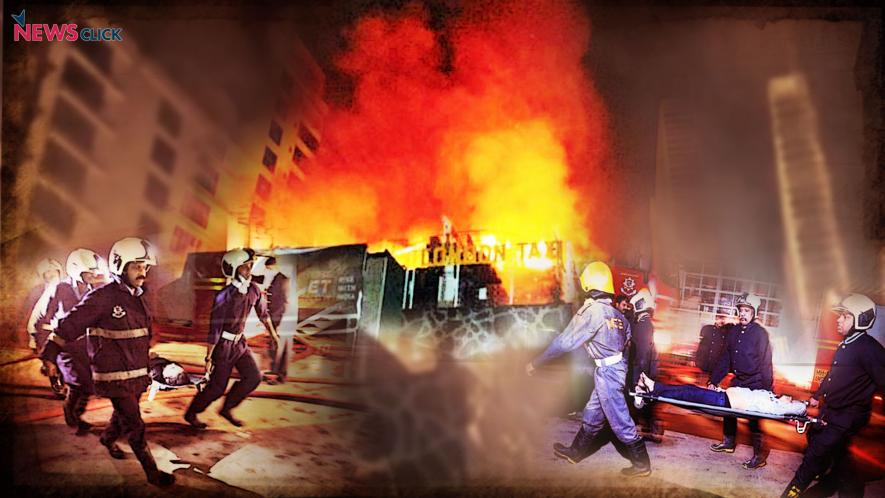
Newsclick Image by Nitesh Kumar
Everybody knows that the dice are loaded
Everybody rolls with their fingers crossed
Everybody knows the war is over
Everybody knows the good guys lost
Everybody knows the fight was fixed
The poor stay poor, the rich get rich
That's how it goes, everybody knows.
Leonard Cohen could very well have been singing about Mumbai, more specifically the mill lands of Mumbai - where once 53 textile mills stood, where textile workers and lakhs of other workers families of Mumbai city dwelt; where a bitter battle over land began in the 90s. The mills have closed and turned into luxury apartments, malls, swank offices, restaurants and nightclubs, and some rich people got a whole lot richer. The 600 acre area once called Girangaon or village of mills, is the story of one of the biggest real estate scams in the country. It is also a place where disasters were only waiting to happen. In September, 22 people died in a stampede on the overcrowded pedestrian bridge in Elphinstone Road station. Three months later, in Kamla Mills, 14 young people went to a birthday party at a fancy nightclub and finished up in the morgue. Innocent lives, sacrificed at the altar of avarice and greed.
600 acres of Girangaon, which is the central part of Mumbai’s island city, represent a mind boggling figure in terms of real estate. But according to the law before 1991 mill land could not be redeveloped since it had been leased a century ago for the sole purpose of setting up textile mills. This was considered unfair by the mill owners sitting on prime real estate. How could they be denied the benefits of speculation, and the real estate boom? They wanted to close the mills, but workers wanted their jobs. Mill owners demanded the be allowed to sell land in order, so they claimed, to revive the ailing mills. The Maharashtra govt. dutifully amended the Development Control Regulations (DCR) of Mumbai city, allowing mill owners to sell and develop mill lands; but with the condition that it had to be divided in more or less equal thirds between 1) the Municipal Corporation of Greater Mumbai (MCGM) for civic amenities including open space; 2) the Maharashtra Housing Area Development Authority (MHADA), for public housing; and 3) the mill owners for modernisation and development of the mills. In exchange for the two thirds that was being given up by mill owners, Transfer of Development Rights (TDR) was granted to them on the two thirds they were giving up, which meant they could use this space outside city limits, in the suburbs.
Some salient points were lost in the middle of all this hectic activity. How did mill owners get the right to use leased property that should revert to the city? Second, if they were to reap a gigantic profit form the increase in price of land, (mostly because of speculation) why should workers not benefit from that as well?
Datta Iswalkar, Secretary of Girni Kamgar Sangharsh Samiti (Mill Workers Action Committee) says, ‘Most of the mills closed down illegally and refused to pay even the paltry sum that was due to the workers. So we fought for jobs. But after 10 years of struggle we could see that the mills would close, and the battle was about land. After a 100-year history in the city, mill workers were being thrown out of the city they created and fought for. That is why we decided to fight for a part of that land and for alternative employment. Textile workers have a long tradition of fighting. We continue to fight but it is very hard.” Although mill workers won a bit of the land, and 20000 houses have been built they are having to fight for the rest of the houses, for every square foot, for every tenement.
One of the loopholes in the law was that mills which only redesigned and reused existing structures, would not have to follow the ‘one third rules’. This was in order to preserve heritage structures that most of the mills represented. This is the loop hole that Kamla Mills exploited. Ramesh Govani the current owner of Kamla Mills bought the property in 1992 from the mill owner Taporia. Govani was not in the business of running mills. The mill was quietly closed, the workers paid off with the connivance of the official union, the one led by the same Congress party which was in government in the state. Govani did not change the old structure, he rented it out to hundreds of shops and establishments, including 65 restaurants which used the prime location, the heritage aesthetics of the building. Kamla Mills was one of the few mills where workers were not part of the struggle against mill closures and eviction after closure. The new owner stayed in the shadows, away from regulations or scrutiny. He built new structures in complete contravention of the DC regulations. It is interesting that while the tenants-restauranteurs in Kamla Mills are being penalized, it is not clear what exactly Ramesh Govani will be accused of. The BMC has to explain- who gave Kamla Mills permission to build new structures inside the mill? Will he be booked for this? And what about the BMC officials who looked the other way while this was happening? How far back is BMC willing to go?
Another loophole was created in 2001- and this led to a legal case which could perhaps have saved the city from these disasters we are seeing today. The Congress led Vilasrao Deshmukh govt of Maharashtra amended the law again, ostensibly in response to the demand from workers and tenants living in the mill tenements. Mills would not be given permissions until they had deposited workers dues. Tenants living in the mill chawls could not be evicted. If land was sold /redeveloped, workers families would have a lean on employment in the new businesses. Within the land provided for public housing (to MHADA), 50% would be set aside for housing textile workers.
However, a small text was added later by the then Secretary of the Urban Development Ministry, Ramanand Tiwari of Adarsh scam fame: the division of the land was made applicable only to ‘open space’ in the mills, land on which there were no structures. Even if the structures had been demolished. Therefore the one third portions each for the city, and MHADA (housing including workers housing) were now miniscule. A citizens group called Bombay Environmental Action Group (BEAG) approached the High court, supported by a host of city based organisations and individuals, including the mill workers. In October 2005, a landmark judgement was delivered in the Mumbai High Court. The judgement gave back the share of mill land that was meant for them to the city and the community. The State Pollution Board was pulled up, strictures were passed against the Municipal Corporation for abdication of responsibility, for giving permissions and commencement certificates before builders and developers had- fulfilled other obligations, like handover of land. This judgement sent shock waves through the mill owner-developer-builder club. They took immediate remedial measures. Slyly supported by the Maharashtra govt, they went to the Supreme Court which then over-turned the Mumbai High Court’s ‘radical’ judgement. It was back to square one, the Maharashtra govt’s ‘interpretation’ stood.
It is worth considering that had the Mumbai High Court’s judgement been allowed to stand, if the Maharashtra government had used the opportunity presented by the High Court judgement to benefit the city, had the Supreme Court not supported the wanton greed of the mill owners, many tragedies including the loss of lives in ‘1 Above’ and the stampede in Elphinstone station may not have happened. Who even remembers the original sinners? The mill owner-developers, Chief Ministers, Chief Secretaries, real estate magnates, big builders, Mafia dons, perhaps few judges too? When the scam is so big, most are either bribed or bullied or both.
In classic knee-jerk mode, the BMC swung into action after the nightclub deaths. By Dec 31 st, they had inspected all the restaurants in the area, many are facing action, they seized illegally stored LPG cylinders, and all or part of the premises of 30 hotels were sealed. BMC has promised action against all the officials of the Municipal Corporation and even politicians who have been part of vast system of corruption involving building permissions and safety norms in the area. Police are chasing the owners of the pub. All very impressive. Except that the stable doors were opened a long time ago and the metaphorical horse has long bolted
One can only hope the people who died at 1Above and on Elphinstone bridge will not have died in vain. It is time that Mumbai’s authorities are held accountable. And for citizens understand that the unplanned, unregulated, profit driven development of Mumbai, powered by the bottomless greed of the real estate market, has resulted in immense pressure on the inadequate services, choked off open, green spaces, put the entire city in danger and extinguished the history as indeed the very core of Mumbai.
*Meena R Menon is co-author of “One Hundred Years, One Hundred Voices: The Millworkers of Girangaon: An Oral History” and has been part of the mill workers for over 15 years. She also works on urban policy and politics.
Get the latest reports & analysis with people's perspective on Protests, movements & deep analytical videos, discussions of the current affairs in your Telegram app. Subscribe to NewsClick's Telegram channel & get Real-Time updates on stories, as they get published on our website.