





Withdraw VB-G RAM G Bill Forthwith, Says NREGA Sangharsh Morcha
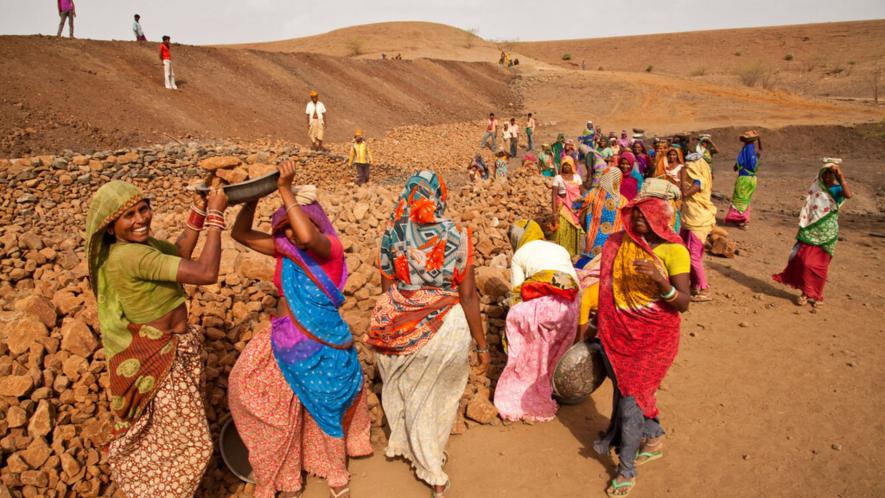
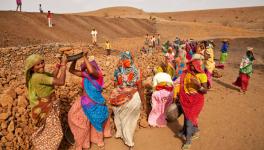
Representational Image. Image Courtesy: Flickr
New Delhi: The NREGA Sangharsh Morcha (NSM) has demanded the immediate withdrawal of the proposed new avatar of the MGNREG Act or MGNREGA, brought in by the Narendra Modi government -- Viksit Bharat - Guarantee For Rozgar And Ajeevika Mission (Gramin) Bill, 2025.
The Morcha, an umbrella of several grassroots organisations, in a statement, said “any attempt to repeal or fundamentally alter MGNREGA without the consent and participation of workers and their organisations is unacceptable.”
It called upon all democratic forces to resist these “unilateral and regressive proposals and to defend NREGA as a cornerstone of livelihood security for millions of rural workers,” as the scheme is being turned into supply-driven rather than demand-driven.
The proposed Bill “represents a fundamental shift from a rights-based law that provides an enforceable entitlement into a budget-constrained scheme without any accountability of the Union Government,” NSM said in a statement, adding that the government is “seeking to dismantle a historic rights-based legislation and reduce the right to work to a discretionary dole.”
It added that the Bill “violates the spirit of the Constitution, undermines the 73rd Constitutional Amendment, and strikes at the core of social and economic justice by shifting power away from workers, Gram Sabhas, and States into the hands of the Union Government.”
Read the full NSM statement below:
The Right to Work Repealed
The NREGA Sangharsh Morcha condemns the proposed Viksit Bharat - Guarantee For Rozgar And Ajeevika Mission (Gramin) Bill, 2025 (VB-G RAM G) that seeks to repeal the Mahatma Gandhi National Rural Employment Guarantee Act, 2005 (MGNREGA). Introduced without any consultation with workers and workers-groups, the bill represents a fundamental shift from a rights-based law that provides an enforceable entitlement into a budget-constrained scheme without any accountability of the Union Government.
● Excessive Discretionary Power for the Centre: MGNREGA establishes a statutory right to work that is demand-driven and universal i.e. any person willing to do unskilled manual work in any rural area must be provided work. But under the VB-G RAM G Bill, Section 5(1) states “the State Government shall, in such rural areas in the State as notified by the Central Government, provide to every household whose adult members volunteer to do unskilled manual work, not less than 125 days of guaranteed employment.” Therefore, if a rural area is not notified by the Centre, there is no right to work for the people of that area, effectively reducing universally guaranteed employment to any other scheme run at the mercy of the Union Government.
● Demand-driven to Supply-based: MGNREGA draws its power from its demand-driven nature i.e., every rural worker must be given work within 15 days, failing which they are entitled to an unemployment allowance. 100% of labour wages are the union government’s prerogative. However, Section 4(5) of the VB-G RAM G Bill states “The Central Government shall determine the State-wise normative allocation for each financial year, based on objective parameters as may be prescribed by the Central Government,” while Section 4(6) further provides that “Any expenditure incurred by a State in excess of its normative allocation shall be borne by the State Government in such manner and by such procedure as may be prescribed by the Central Government.” This enables the Union Government to arbitrarily decide the quantum of funds to be allocated to states which, in turn, will determine how many days of employment can be provided in that state. This completely upends the logic of MGNREGA where funding follows demand to a supply-driven system where demand must conform to a pre-determined budget
● Burdening of States: Under MGNREGA, the Union Government is responsible for 100% labour wages and 75% of the material wages. In practice, this translates to a 90:10 cost share between the Centre and the States. Section 22(2) of the G-RAM-G bill provides that “the fund-sharing pattern between the Central Government and the State Governments shall be 90:10 for the North Eastern States, Himalayan States and Union territory (Uttarakhand, Himachal Pradesh and Jammu and Kashmir) and 60:40 for all other States and Union territories with legislature.” This clause not only puts a massive burden on states, but also disproportionately impacts poorer and high migrant-sending states which are more in need of rural employment. The increased financial burden will lead to states resorting to fiscal conservatives and not registering workers’ demand for work.
● Bottom-up to Top-Down: In accordance with the 73rd Constitutional Amendment, in MGNREGA, the planning of works was done through Gram Sabhas based on local needs. But this provision is overturned by Schedule 1, clause 6(4) of the VB-G RAM G Bill which states that “Viksit Bharat National Rural Infrastructure Stack shall guide States, Districts and Panchayati Raj Institutions in identifying priority infrastructure gaps, standardising work designs, and ensuring that public investments contribute measurably to saturation outcomes at the Gram Panchayat, Block and District levels.” By shifting the planning process from local to a pre-defined centralised priority system of a ‘National Rural Infrastructure Stack’ would subvert the 73rd Constitutional Amendment.
● Technocratic Monitoring and Surveillance: Workers’ organisations have repeatedly highlighted widespread exclusions resulting from the imposition of opaque, arbitrary technologies in MGNREGA like digital attendance (NMMS) and Aadhaar-based payment systems (ABPS). Despite this, the VB-G RAM G Bill seeks to introduce a framework rooted in top-down, technology-driven surveillance by mandating the use of biometric authentication for MGNREGA workers and functionaries as well as the use of geospatial technology and geo-referencing of works. Biometric authentication is fraught with problems, particularly for agricultural and manual labourers, as evidenced by numerous studies and ground reports.
● Year-round Right to work to Blackout Periods: Any rural resident can demand and get work at any time of the year in MGNREGA. Section 6(2) of VB-G RAM G bill states “The State Governments shall notify in advance, a period aggregating to sixty days in a financial year, covering the peak agricultural seasons of sowing and harvesting, during which works under this Act, shall not be undertaken.” Workers, especially women workers, in need and willing to work, will now be legally deprived of work for at least 2 months.
The VB-G RAM G Bill is not a reform but a rollback of democratic and constitutional guarantees won by workers through decades of sustained struggles. By replacing the statutory right under MGNREGA with a centrally-controlled, budget-capped and surveillance-heavy scheme, the Union Government is seeking to dismantle a historic rights-based legislation and reduce the right to work to a discretionary dole. This Bill violates the spirit of the Constitution, undermines the 73rd Constitutional Amendment, and strikes at the core of social and economic justice by shifting power away from workers, Gram Sabhas, and States into the hands of the Union Government.
The NREGA Sangharsh Morcha unequivocally rejects the VB-G RAM G Bill, 2025, and demands its immediate withdrawal. Any attempt to repeal or fundamentally alter MGNREGA without the consent and participation of workers and their organisations is unacceptable. We call upon all democratic forces to resist these unilateral and regressive proposals and to defend NREGA as a cornerstone of livelihood security for millions of rural workers.
Allied Organisations of NREGA Sangharsh Morcha:
Anna Suraksha Adhikar Abhiyan, Chhattisgarh Kisan Mazdoor Sangathan, Dalit Bahujan Front, Grameena Koolikarmikare Sangathane, Gram Vikas Manch, Jagrit Adivasi Dalit Sangathan, Jan Jagran Shakti Sangathan, Jagruta Mahila Okkutta, MGNREGA Majdoor Union - Banaras, MGNREGA Majdoor Union - Haryana, Mazdoor Kisan Shakti Sangathan, Majdoor Navnirman Sangathan, National Federation for Indian Women, Jharkhand NREGA Watch, Paschim Banga Khet Majoor Samity, Paschim Banga Cha Majoor Samity, Pravasi Majdoor Sanagthan, Rajasthan Asangathit Majdoor Union, Rashtriya Seemant Kisan Majdoor Union, Samalochana, Jan Vikas Shakti Sangathan, Sangatin Kisan Majdoor Sangathan, Soochna Evum Rozgar Adhikar Abhiyan, Swabhimani Mazdoor Sangathan, Right to Food and Work Network - West Bengal, Right to Food Campaign, Ambedkarism Punadi Association, Samaj Parivartan Shakti Sangathan, Bhakhar Bhitrod Vikas Manch, Odisha Khadya Adhikar Abhijan.
Get the latest reports & analysis with people's perspective on Protests, movements & deep analytical videos, discussions of the current affairs in your Telegram app. Subscribe to NewsClick's Telegram channel & get Real-Time updates on stories, as they get published on our website.