





Workers, Farmers Observe ‘National Resistance Day’ on Jan 16
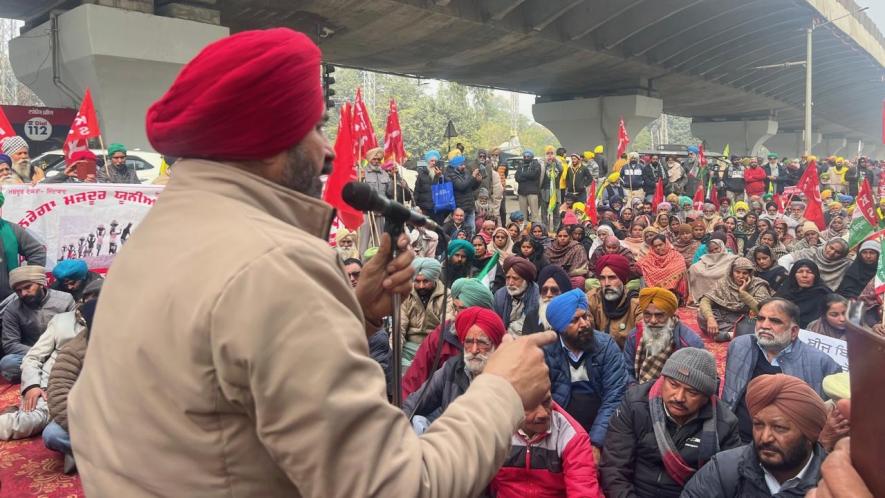
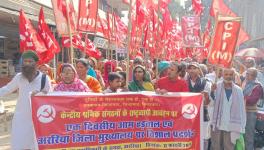
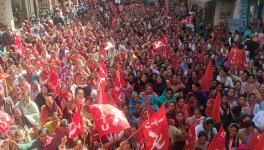
Commemoration of National Day of Resistance in India. Photo: AIKS
Samyukta Kisan Morcha (SKM) and Central Trade Unions (CTUs) in India jointly organized the National Day of Resistance on Friday, January 16, to oppose the neoliberal assault on workers and farmers by the ultra-right-wing government in the country and to pledge to build a bigger movement against it in the coming days.
In the run-up to the day, thousands of farmers, workers, and progressives have been staging demonstrations in their villages, towns, and workplaces throughout the country against the government’s recent policy announcements, including:
- The imposition of four new labor codes
- The introduction of the electricity bill
- The repealing of the rural employment guarantee program (in place for the last two decades)
SKM is a national collective of farmers’ groups which led the 2020-21 agitation in Delhi against three farm laws. CTUs is made of all major trade union federations in the country, excluding the ultra-right-wing groups, as a platform to resist state’s anti-worker moves.
The protesters took a collective pledge to resist all pro-corporate anti-workers policies with full strength and launch an agitation until the government is forced to withdraw the new seed and electricity bills, four new labor codes, and its decision to repeal the rural guarantee act.
Farmers and workers in India have been protesting against the introduction of four new labor codes for the last few years.
Since their implementation in November, the CTUs along with SKM, organized a national strike and multiple protests, claiming the new codes threaten the collective bargaining of the workers and deprive them of most of the rights they won through decades of struggle.
Anti-people policies
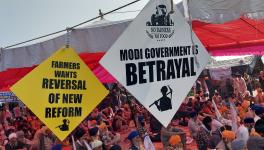
The text of the pledge issued by the SKM claims that the Narendra Modi-led government in the country has betrayed the promises made at the time of December 2021 agreement which led to the withdrawal of the agitation, and introduced bills and policies such as the new Electricity Amendment Bill (EAB) 2025 which would gravely harm the interests of the farmers and workers in India.
Around half of India’s working population is still involved in agriculture, with most having no or very limited ownership of lands and are highly dependent on state subsidies for their survival.
SKM claims that the EAB 2025 introduces “higher and uniform tariffs for all, doing away cross subsidies to the weaker sections, including that for agriculture and imposing pre-paid smart meters.”
Similarly, the Seeds Bill 2025 introduces complete market control by corporations and multinational companies (MNCs) over the supply of seeds.
SKM underlines that “this will drastically change the cropping pattern, detrimental to subsistence farming and endanger the seed sovereignty and food security of the country.”
The withdrawal of the National Rural Employment Guarantee Act (MGNREGA) and its replacement with a weaker law called the VB GRAMG Act 2025, SKM argues, “takes away the right to work and job guarantee for at least 100 days”, and withdraws “work on demand” as was provided in the previous law.
Named after Mahatma Gandhi, the NREGA was enacted in 2005. It was a result of years of popular struggle waged by the left groups in the country for the right to work. It provided guaranteed employment in rural areas to millions of landless and small peasants.
The new law “while drastically cutting down the allocations, contrary to the false claim of 125 days’ work per year, also puts an additional burden of 40% on the state governments” who are struggling to get money to fund their existing welfare schemes, practically making it impossible to effectively implement.
SKM notes that the four new labor codes which “take away the rights achieved through decades of struggles-rights to form unions, minimum living wages, secured employment, 8 hours’ work, social security and safety at the workplace” is “pushing the working class as the slaves of corporate capital” and it must be withdrawn.
Protecting India’s democracy and its secular ethos
The SKM pledge claims the united struggle of workers and peasants is also aimed at resisting the growing suppression of dissent under the Modi-led Bharatiya Janata Party (BJP) government, through the use of draconian laws, curbing of free speech and the destruction of rule of law.
“We note with serious concern the efforts of the RSS-BJP combine and their government destroying the secular fabric of our country and the unity of the people.”
RSS or Rashtriya Swayamsevak Sangh is a militia with the agenda of turning India into a theocratic state for the Hindus. It controls the BJP.
It is claimed that religious minorities have increasingly been targeted under the Modi government through the subversion of rule of law and promotion of majoritarianism.
“We understand that all these measures of serious attack on the lives and livelihood of the working people is an effort by the corporate communal government to come out of the serious crisis of neoliberal capitalism and serve the interests of the multinational and Indian corporate houses and the super rich of the country,” SKM proclaimed.
The SKM also accuses the government of “shamelessly surrendering to US imperialism, betraying the interest of the Indian agriculture and Industry”, claiming “the Free Trade Agreements are to open the Indian economy to the loot of Multi-National Corporations.”
Despite the opposition from the SKM and others, India signed a trade agreement with the UK last year. Talks for a similar agreement are underway with the US.
Sudip Dutta, president of the Centre for Indian Trade Union (CITU), one of the largest constituents of the CTUs, vowed that the workers and farmers in the country will not let the government impose its pro-corporate and anti-people policies.
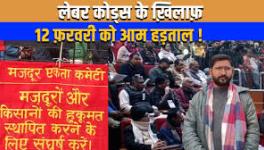
Dutta announced that the National Day of Resistance would be followed by a national strike on February 12 to push for the collective demands of peasants, agricultural workers, and the industrial working class. He warned that even after this, if the government does not listen to their demands and withdraw anti-people policies, there will be greater and longer strikes in the coming days.
Courtesy: Peoples Dispatch
Get the latest reports & analysis with people's perspective on Protests, movements & deep analytical videos, discussions of the current affairs in your Telegram app. Subscribe to NewsClick's Telegram channel & get Real-Time updates on stories, as they get published on our website.