





Weaponising Idiocy: Milk-Drinking Ganesha to Taali Bajao
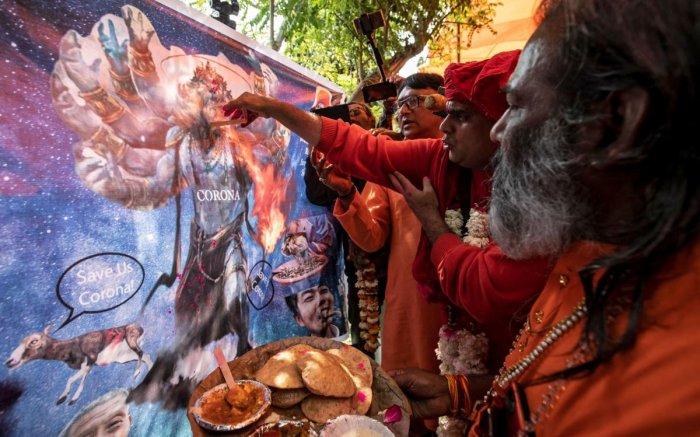
Representational image. | Image Courtesy: Deccan Herald
Yad ihasti tad anyatra, yan nehasti na tat kavcit. ‘Whatever is here might be elsewhere, but what is not here could ever be found’.—The Mahabharata, 1.56.33, from Meera Nanda’s The God Market: How Globalisation is Making India More Hindu, Random House 2009.
It was the fag end of the 1st decade of the 21st century when the historian Rink Shenkman wrote his marvellous book, Just how stupid Are We? Facing the Truth about the American Voter. In an interview, he said that Americans are “ill-prepared” to guide the world’s “most powerful” democracy. The book points out the astounding inability of even “two of five voters” to name three branches of the federal government, the fact that half of Americans think that their president can suspend the Constitution, and a large section’s ignorance of the 9/11 attack and the Iraq war that followed.
His concern was the mass of people who could easily, repeatedly and systematically be misled and manipulated by politicians and further “dumb down” American politics.
This “stupidity” was on full display in images of rowdy college crowds hitting California’s beaches during spring break, prompting the governor to close them down. New York governor Andrew Cuomo warned that “young people are not Superman/woman” when it turned out that people, especially the young, are not socially distancing themselves. But only Americans are not to blame. Media tells us that “virus rebels” are displaying their stupidity virtually all over the Western world, prompting crackdowns by authorities.
There’s perhaps no similar study for South Asia, especially India, probing our “stupidity” in this crisis-time, though there’s immense fodder for it.
Are we not the only country where Science Congresses have invited lectures from “scholars” who proclaim we possessed aeroplanes thousands of years ago? And the only country where cow urine and cow dung are peddled as solutions to serious medical conditions which even modern sciences have not found, from Covid-19 to nuclear radiation? A country whose citizens spend lakhs of rupees to make their homes and offices Vastushastra-ready? And where people are ready to congregate by the millions for ‘holy’ men and women convicted or accused of heinous crimes.
The deadly contagious Novel Coronavirus has overwhelmed the world in less than three months. This has provided an opportunity to gauge the level of wisdom exercised by Indian people, even in normal times.
At present there is no cure to the Covid-19 disease caused by this virus, which has infected more than 4,23,142 people an caused more than 16,000 deaths. Italy, the eighth-largest economy, with one of the best public health systems, is a symbol of how tremendous this scourge is. More than 6,800 have succumbed to this virus in Italy.
The World Health Organization has pointed out that it took 67 days for the the first 1,00,000 cases to be reported, 11 days for the second 1,00,000 and only four for the third 1,00,000 cases. Apart from quarantining potential cases and providing medical assistance to the infected, social distancing is said to be the only way to stop its spread.
Yet, people reacted to the Janata curfew proclaimed on 22 March by the Prime Minister, ostensibly in solidarity with health workers and doctors who are battling the epidemic with resorting, at first, to rumours—including fake news propagated by some right-wing IT cells. There was talk of how clapping hands can kill viruses and a-day long curfew breaking the chain of virus multiplication. The Press Information Bureau had to issue a fact-check denying the rumour about clapping destroying the virus.
Secondly, people showed no qualms in turning the whole idea of social distancing on its head. They organised processions, raised slogans, clanged vessels, played traditional instruments in crowds, and asked the infection to “go away”. This happened across India.
The office of the Karnataka governor was no exception. Scores of people gathered there and the governor led them in clanging away. In Pune, on social media, people reported that a DJ had been summoned at 5 pm to a housing society. And, in Pilibhit, the district magistrate and the city Superintendent of Police led a big procession, both clanging vessels and blowing a conch shell and so on.
These gatherings obviously cared two hoots for the scientifically-proven fact that one carrier of Novel Coronavirus, who might not have obvious symptoms of being infected, can infect hundreds of others, leading to exponential spread of the disease. How does one comprehend these “celebrations”, despite fears that India could be the next Coronavirus hotspot, with as many as 60% getting infected?
Clearly, there is great hiatus between what Indians claim about themselves and the actual situation. India’s Constitution says it must develop the scientific temper, humanism and the spirit of inquiry and reform in Article 51 A, but this idea is only superficially accepted even seventy years later. A large majority still believe in irrational, unscientific phenomenon.
Even opinion makers suffer from what is known as the “cognitive bias of illusory superiority”. This is what creates in them an “inability to recognise their lack of ability,” as social psychologists David Dunning and Justin Kruger have described this phenomenon. There is a “miscalibration” at work, according to these two experts. There is among the incompetent an error about the self on the one hand and there is also a miscalibration about the competence of others. This is what has come to be known as the Kruger Effect, and it seems to apply perfectly to India, whose people considers (and proclaims) themselves a “Vishwa Guru” or teacher for the world.
A global attitudes survey done by the American think-tank, Pew Research Centre, in 2007 had found that Indians consider themselves “number one in the world”. It had asked people in 47 countries if they agreed or disagreed with this question: “Our people are not perfect, but our culture is superior to others.” Indians topped the list in agreeing with this premise.
A whopping 93% agreed that Indian culture was superior to others, and 64% agreed without any reservations. Only 55% Americans believed in the superiority of their culture, as did 69% of Japanese and 71% Chinese.
Markandey Katju, a retired judge of the Supreme Court, learned the effect of this belief the hard way a few years back when he stated that “90% of Indians are idiots”, easily misled by mischievous elements in the name of religion.
Instead of trying to refute him with arguments, which would not have been possible examining society more critically and objectively, this retired judge was lambasted and criticised, including by those who indulged in “nationalist”-sounding rejoinders. This feeling of “superiority” has been boosted by the ascent of Hindutva majoritarianism and it has, in turn, been cleverly used by the proponents of Hindutva.
Exactly 25 years ago, rumours of Ganesha idols sipping milk spread across the country. People gathered at temples in the thousands to catch a glimpse of this “miracle”. The news spread and Hindu communities across the world started reporting similar “miracles”.
The news spread although there was no internet, smartphone, Facebook or WhatsApp. It is obvious that without an organisation, a conservative Hindutva organisation in particular, it would have been impossible to spread such a rumour. This “successful” experiment in mass psychology can be considered a trial run for other social trials.
To violate the basic need to keep citizens safe by celebrating in the midst of a pandemic is, basically, a criminal act. Such an event would not be organised by a people who are not gullible. Their intelligence will truly come into question if they now try to argue that what happened was a “spontaneous” affair.
The author is an independent journalist. The views are personal.
Get the latest reports & analysis with people's perspective on Protests, movements & deep analytical videos, discussions of the current affairs in your Telegram app. Subscribe to NewsClick's Telegram channel & get Real-Time updates on stories, as they get published on our website.