






IISc Team Claims to Have Developed Superconducting Material Usable at Room Temperature
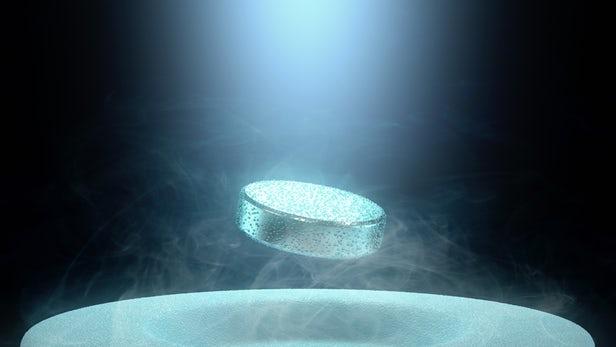
Image for representational use only.Image Courtesy : Newatlas.com
The controversy regarding the claim of having developed a super conducting material under room temperature has resurfaced. In 2018, Anshu Pandey and Dev Kumar Thapa, the two scientists form Indian Institute of Science (IISc), Bangaluru, had reported to have developed a nanostructured gold-silver composite material that shows super conductivity under ambient temperature and pressure. They had submitted their findings for the Cornell University’s preprint repository, arXiv in July 2018.
However, noted scientists from across the world became very skeptical of their claim because their manuscript lacked the details that could provide a solid support to their work. Moreover, there were several flaws in their data. Massachusetts Institute of Technology (MIT) physicist Brian Skinner also pointed to a pattern in their data which should not have been there.
The lack of details so as to reproduce the experiment and the results was also a feature that was highly criticised.
The Latest Revision
In the latest revision done by the IISc scientists that appeared in arXiv on May 28, advancement in many aspects could be observed. First of all, they have enlarged their sample set to a good extent and also increased the numbers of collaborators in their team to 10. They reported to have investigated 128 nanostructured samples of silver-gold composites, compared to just 33 samples in their earlier report.
The team has also reported to have seen nine samples in total to display near zero resistance—the hallmark of superconductivity. The resistivity, according to the upgraded report, is 10,000 times lower than that of good metallic conductors like gold, copper, silver.
The team has also reported that the superconducting transition temperature is now 286 K, that is almost 13 degree Celsius, in comparison to the previous transition temperature of 236 K. This is remarkable, because 13 degree Celsius is very near to room temperature. It’s pretty ambient.
With enhanced sample size and more detailing in the report, specialists are saying that the results may be reproducible in many labs. Had this been done, their work will be a milestone in physics. But the validation of their results is still awaiting.
Difficulties in Achieving Superconductivity
Superconductivity is the phenomenon where a material gives almost zero resistance to the flow of electrons through it. The temperature below which a material shows superconductivity is called the critical temperature (Tc). Normally, superconductivity is shown at a much lower temperature—almost -240 degree Celsius to -243 degree Celsius. Obtaining this temperature is very energy-consuming and is pretty difficult. Since the mid-20th century, scientists have been thriving to develop material that shows superconductivity near room temperature.
Get the latest reports & analysis with people's perspective on Protests, movements & deep analytical videos, discussions of the current affairs in your Telegram app. Subscribe to NewsClick's Telegram channel & get Real-Time updates on stories, as they get published on our website.