





Bengal: How Adi Ganga River Was Turned into a Drain & Why a New Barrage Could End Job
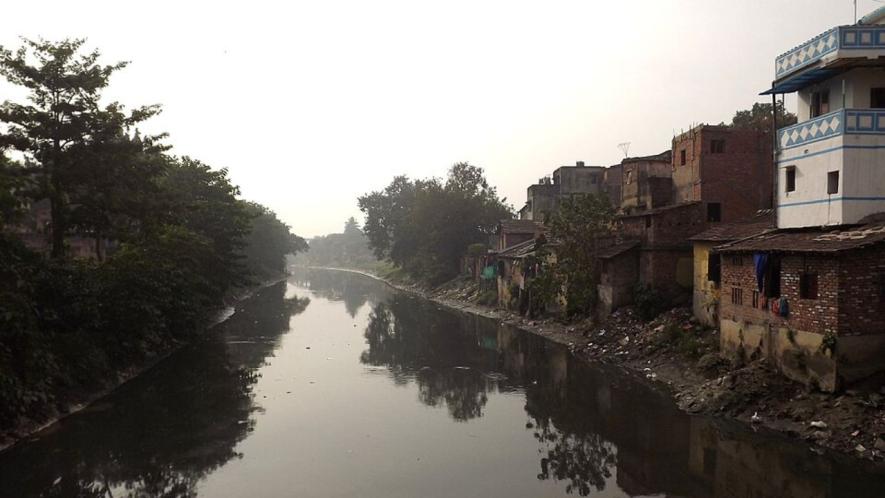
Image Courtesy: Wikimedia Commons
Kolkata: On a humid September evening, as the monsoon rain lashed South Kolkata, 39-year-old Purnima Modak stood ankle-deep in murky water inside her one-room hutment near Garia station. By nightfall, the water level had risen further, submerging clothes, utensils and the few possessions she owns. The floodwater had entered from the Adi Ganga—a river that once carried boats, trade and tide, but today resembles little more than a stagnant, polluted drain.
Purnima, a divorcee, who earns her living selling flowers at the local Garia market, has lived beside the Adi Ganga for over three decades. Her father migrated from Bongaon in North 24 Parganas when she was three years old, settling along the river’s edge at a time when river water still flowed and fishing was possible.
Today, she lives with the consequences of a river slowly killed by neglect, encroachment and infrastructure projects—most of them state-sponsored. So, when news spread that the West Bengal government is planning to construct a barrage near the mouth of the Adi Ganga where it meets the Hooghly, her reaction was one of anger.
“Eta bhishon baje project (this is a bad project),” she said, adding “This will block the river even more. If waterlogging is this bad now, imagine what will happen after the barrage.”
She pointed to the Kudghat sluice gate and the concrete pillars of the Kolkata Metro that slice across the river. “Development has already killed it,” she said, adding “Now they want to bury it completely.”
A Barrage Without a River
The fear that residents like Purnima have is rooted in an official decision that has so far escaped sustained public scrutiny. On January 24, 2022, the West Bengal Chief Secretary, in a meeting with the Kolkata Municipal Corporation (KMC), directed officials to construct a barrage at the Adi Ganga–Hooghly confluence near Outram Ghat. The estimated cost of the project is ₹135 crore.
The stated objective, according to internal documents, is to regulate water flow and improve “aesthetic restoration.” But river experts and environmental planners warn that any such intervention—especially at the river mouth—without first restoring the upstream flow, is ecologically disastrous.
Civil society groups, environmentalists and river scientists have now come together to oppose the project. A convention scheduled for January 10 is expected to bring together hydrologists, urban planners, engineers and residents from across the Adi Ganga basin.
Dipankar Singha, former Director General of Town Planning for Kolkata, calls the barrage “a classic example of engineering arrogance.”
“You cannot regulate what no longer flows,” Singha said. “The Adi Ganga has been fragmented, encroached upon and strangled upstream. Blocking tidal exchange at the mouth will only increase stagnation, flooding and pollution.”
According to Singha, the proposal reflects a deeper institutional failure to understand rivers as ecological systems rather than linear drains to be managed with gates and concrete.
From Sacred Channel to Sewer
Historically, the Adi Ganga was not a minor canal but one of the principal distributaries of the Ganges. Scholars believe it was the main channel through which the Ganga flowed into the Bay of Bengal until tectonic shifts and sedimentation altered its course around the 16th century.
Archaeological discoveries along its banks—coins, stone idols, wooden boats and skeletal remains -- in areas like Lashkarpur, Garia Bazaar, Baishnabghata and Baruipur, point to a thriving riverine civilisation. Medieval merchant vessels are believed to have travelled through this route, connecting Bengal to Southeast Asia, Sri Lanka and the Arakan coast.
Local folklore speaks of Chand Saudagar, the legendary merchant of Bengal, whose boat is said to have capsized near present-day Garia Bazaar. A centuries-old Shiva temple near the Garia cremation ghat still stands as a reminder of the river’s earlier course.
“In the early 1980s, boats could reach Kudghat and even parts of Garia,” recalled Angshuman Das, a 45-year-old management professional who grew up near the river. “After desiltation in the 1990s, navigation briefly returned. Then came the Metro. That was the final blow.”
The construction of the north-south Metro corridor in the late 1990s introduced massive concrete pillars across the river, severely constricting flow. What followed was a slow ecological death.
Encroachment as Policy
Across large stretches of Rajpur Sonarpur and southern Kolkata, the Adi Ganga has effectively been forced underground. Encroachments—both informal settlements and permanent constructions—have narrowed the river to a fraction of its original width. In some areas, the surface channel has disappeared entirely.
While the river re-emerges near Baruipur and Joynagar-Majilpur, hydrologists warn that upstream damage has permanently altered the basin’s hydrology. Floodplains have been built over, natural drainage paths erased, and tidal exchange disrupted.
Ironically, one of the few stretches protected from encroachment lies beneath the Eastern Metropolitan Bypass—saved not by environmental foresight, but by transport infrastructure.
Despite multiple litigations in the Calcutta High Court and Supreme Court, state response has largely been limited to the formation of fact-finding committees. Under successive governments, even stretches once protected under the Ganga Action Plan have been reclassified as “environmental hazards,” paving the way for further intervention rather than restoration.
Namami Gange and the Politics of Failure
The Adi Ganga is officially recognised as a tertiary channel of the Ganges under the National Ganga Council. Under the Namami Gange programme, it was to be cleaned to maintain acceptable coliform levels in the Hooghly, which is considered the final stretch of the Ganga in West Bengal after Farakka.
Yet, environmental activists point out that this recognition exists largely on paper.
Not a single sewage treatment plant along the Adi Ganga functions effectively. Untreated domestic sewage and industrial effluents continue to flow into the river, turning it into a toxic drain. Groundwater in surrounding neighbourhoods is increasingly contaminated, while vector-borne diseases such as dengue have become seasonal constants.
“The barrage proposal comes without addressing the complete collapse of sewage treatment,” said an environmental engineer associated with the anti-barrage movement. “You are trying to regulate polluted stagnation instead of removing pollution.”
Real Estate, Elections and the River
As West Bengal enters another election cycle, the Adi Ganga has once again become politically visible. Small and medium real estate operators are already positioning themselves to benefit from “restoration” projects along the nearly 75-km river corridor.
In areas like Patuli, real estate whisper campaigns project the locality as a future “model suburb,” riding on the promise of riverfront development. At least two to three Lok Sabha constituencies fall along the Adi Ganga basin, making it electorally significant.
Before 2011, the Left Front government refused to grant land pattas to refugee families settled along Tolly’s Nullah and the Adi Ganga, citing environmental concerns. That policy, however, did not prevent illegal land transactions during earlier Congress regimes.
The Bharatiya Janata party (BJP) has promised “restoration” of the Adi Ganga, though without clarifying whether this would involve eviction, rehabilitation or compensation. Ruling Trinamool Congress leaders have made similar promises but remain non-committal on reclaiming encroached land.
Kamal Ganguly, former chairman of Rajpur Sonarpur Municipality and a CPI(M) leader, insists that river restoration cannot bypass the question of reclamation.
“You cannot legalise encroachment and call it rejuvenation,” he said. “First reclaim the river, then talk about rehabilitation.”
Lives on the Edge
For residents living along the river, these debates are not about policy abstractions. They are about survival.
Waterlogging has become routine. Drinking water sources are contaminated. Dengue outbreaks return every year. During heavy rainfall, entire neighbourhoods go under water because the river can no longer drain excess flow into the Hooghly.
“If they block the river further, we will drown,” Purnima Modak said quietly.
Her fear is echoed across the basin—from Garia to Baruipur—where the Adi Ganga is no longer seen as a river, but as a threat.
A Choice Still Unmade
As civil society prepares to challenge the barrage proposal, the Adi Ganga stands at a critical juncture. One path leads to ecological restoration—reclaiming floodplains, removing obstructions, treating sewage and allowing the river to breathe again. The other leads to irreversible engineering, real estate-driven beautification and further ecological collapse.
The choice is not merely about a barrage. It is about whether urban governance in Bengal can move beyond concrete-driven solutions and acknowledge rivers as living systems—and whether the lives of people like Purnima Modak count in that decision.
For now, the Adi Ganga waits—buried under neglect, flowing only in fragments, carrying the memory of a river that once shaped Bengal’s history, and the warning of what happens when development erases ecology.
Get the latest reports & analysis with people's perspective on Protests, movements & deep analytical videos, discussions of the current affairs in your Telegram app. Subscribe to NewsClick's Telegram channel & get Real-Time updates on stories, as they get published on our website.