





Democracy in Dust: What ‘Vote Chori’ Rally Reveals About Electoral Anxiety
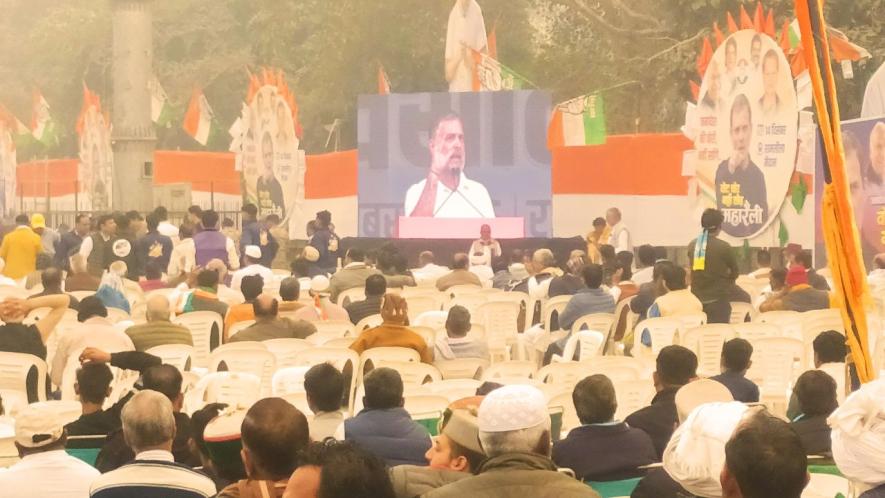
Image Courtesy: Ayaskant Das
New Delhi: Braving the winter chill and the choking air of the national capital, the people who gathered at the “vote chori” mega rally at Delhi’s Ramlila Grounds on December 14, reflected not just anger over alleged electoral malpractices of the Narendra Modi government, but also an emerging search – however tentative – for ways to reclaim faith in India’s democratic process.
The attendees, mostly Congress workers, travelled by trains and buses from across the country for what was the first public rally by the Opposition to red-flag allegations of an unholy nexus between the Election Commission of India (ECI), the Modi government and the ruling Bharatiya Janata Party (BJP), which it said had hijacked electoral democracy and reduced elections to a mere sham.
At the rally ground, the politics of protest unfolded in a setting as raw as the anger it sought to channel. A sharp smell of urine hung heavy near the entry gate, giving way to a vast, dust-laden expanse inside, where temporary canopies erected by different units of the Congress offered little more than symbolic shelter. Political workers, many dressed in traditional attire from their home states, milled about the ground, lending the gathering a distinctly pan-Indian character.
Amid the crowd, one attendee stood out – dressed as Bhim Rao Ambedkar, the architect of the country’s democracy, with a copy of the Constitution of India held aloft. The ground was strewn with pamphlets fashioned as alleged fake voting slips, turning the very venue into a tableau of the party’s charge that India’s democratic promise is being hollowed out.
Senior leaders, including Rahul Gandhi, Priyanka Gandhi and Congress party president Mallikarjun Kharge, took digs at the Modi government and BJP from the stage for the alleged taming of the ECI and the erosion of its independent character. This correspondent spoke to several workers milling around to gather their understanding and insight of the threats posed to democracy through alleged “vote chori”.
“How do we break the corrupt system from outside? That’s the big question that is staring us in the face. The answer is not easy to find. This rally, though, is a small initiative to help the country restore its democratic and Constitutional values. If one were to give a parallel, this effort is akin to the much-touted success of the sustained and collaborative work undertaken by previous Congress governments to bring an end to the polio disease,” Kanhaiya Lal Chauhan (42), a party worker from Gorakhpur in Uttar Pradesh, told this correspondent.
Breaking free from what the Congress describes as a hijacked system of electoral democracy increasingly resembles a Catch-22: an inescapable paradox in which the very mechanism meant to deliver change is seen as compromised. Numerous party workers interviewed by this correspondent at the rally spoke of a shared dilemma: how to dismantle an alleged nexus through the instrument of universal adult suffrage when that instrument itself, they contend, has already been captured.
For most attendees, the dilemma remains unresolved. Many had arrived at the rally at the call of senior leaders, articulating their disquiet with confidence, but pausing when pressed on what a workable pathway forward might look like. Beyond a shared sense of grievance, clear answers on how to navigate a system they believe is stacked against them were few and far between.
But, for many others, the effort to seek reform from within this framework is a cautious belief that sustained pressure, incremental reform and public vigilance could still prise open spaces for restoring the electoral system’s credibility.
“The ECI is guilty of misconduct and the BJP is corrupt. Before 2024, voters could hardly fathom that vote chori could happen in such a manner. But sustained efforts by our leader Rahul Gandhi, has opened Pandora's box. From investigations, it appears that even Modi was losing his seat from Varanasi in the Lok Sabha polls of 2024 until he surged ahead, during the counting process, as if by some divine intervention. These findings have not been built on thin air but through meticulous research. Why not press for a joint parliamentary committee or an independent judicial commission to further research these findings? These have been levelled by the leader of Opposition, after all, in the Lok Sabha,” said 70-year-old Kanhaiya Lal (not the Kanhaiya Lal quoted above), a Congress worker from Ghazipur in Uttar Pradesh.
An elderly Congress worker attempted to situate the present churn within a longer historical continuum, recalling the Quit India movement of 1942 as a time when uncertainty, rather than clarity, defined the struggle. There was no agreed roadmap then either, he said, only a collective resolve that slowly gathered force across the country.
“In 1942, we did not know exactly how or when freedom from the British would come,” 96-year-old Nirmal Das remarked, pausing between sentences. “But the will of the people and the determination of ordinary freedom fighters carried the movement forward – and that, in the end, is what compelled the British to leave,” said Das, who had witnessed the freedom struggle as a young lad and was a special invitee to the rally from Gurdaspur district of Punjab.
Amid the hordes of workers, a few younger participants effused optimism and ideas, among them 28-year-old Ajay Ramesh Yadav, from Sahibganj in Jharkhand.
“There are many ways to dismantle the corrupt system if our top leaders show adequate political will to bring about the changes. The party can push for the ECI to make CCTV footage of polling centres public or livestream polling from each booth on its own website. One option could be the linking of Aadhaar numbers, whose efficacy the Modi government has repeatedly emphasised, with each voter’s electoral photo identity card, to prevent multiple voting,” Yadav said.
Yadavm who holds the designation of National Secretary (Youth) in the overseas unit of Congress party in the UK, raised pointed questions over the Modi government’s reluctance to disclose who has custody of the source codes that govern electronic voting machines (EVMs), arguing that such opacity strikes at the heart of electoral credibility. He linked this secrecy to orders by the ECI in June 2025, pushed through with unusual haste, that mandate the deletion of CCTV footage from polling stations – moves which, taken together, he said, point to a pattern rather than coincidence.
In June 2025, the ECI had instructed its state units to destroy CCTV footage and webcasting and video footage of the election process after 45 days, if the verdict is not challenged in courts within that period, apparently to avoid alleged “false narratives”. This move came in the backdrop of Rahul Gandhi’s demand to the ECI to provide CCTV footage of the Maharashtra Assembly elections held in November 2024, which he has alleged was rigged.
“When the code that runs the machines is hidden and visual records of the polling process are erased,” Yadav said, “it begins to look less like administrative efficiency and more like collusion.”
(Note: At a press conference in New Delhi in August 2025, Chief Election Commissioner Gyanesh Kumar had also claimed that sharing CCTV footage from polling stations could compromise the dignity of women voters – a justification that was quickly met with ridicule. Critics questioned how the same state that thrives on ubiquitous surveillance suddenly discovered modesty at the ballot box. The remark became instant fodder for social media, spawning memes that juxtaposed the ECI’s newfound concern for dignity with everyday public cameras, turning Kumar’s words into a symbol of what many saw as selective transparency and institutional opacity.)
Yadav, like many others in the rally, did not hold back in voicing the Congress’s critique of the current system, calling for a return to paper ballots to restore trust in the voting process. “Gone are the days when booth capturing and theft of ballot boxes thrived on the remoteness of polling centres, poor communication facilities and lack of adequate law enforcement potential with state governments,” he said. “We are not asking for a step backward; we are asking for safeguards that ensure every vote counts, without depending solely on machines whose integrity is kept behind closed doors.”
In the view of those advocating for the scrapping of the EVM (electoral voting machine) system, paper ballots would not only make the process more transparent but also reconnect voters with a system whose credibility, he argued, has been eroded by secrecy and alleged manipulation.
During a debate on electoral reforms in the ongoing winter session of Parliament, Opposition leaders in the Lok Sabha have made a strong pitch for returning to paper ballots in elections. It has been argued that while the reliability of EVMs has been eroded owing to secrecy and questions raised over electronic data tampering, a return to the paper ballot system will restore confidence of the electorate in the electoral process.
The ruling BJP hit back saying that it was the Congress that had introduced EVMs in the first place after complaints of vote rigging by other political parties over several years. The ruling party’s MPs have argued that paper ballots would bring back the dark days of booth capturing.
Notably, many advanced countries, such as France, Germany, Ireland, Italy, Japan, the Netherlands and the United Kingdom have rejected the use of EVMs, fundamentally over issues concerning lack of transparency and possibilities of vote manipulation. These countries have returned to the process of paper ballots to elect their political representatives.
The writer is an independent journalist.
Get the latest reports & analysis with people's perspective on Protests, movements & deep analytical videos, discussions of the current affairs in your Telegram app. Subscribe to NewsClick's Telegram channel & get Real-Time updates on stories, as they get published on our website.