






Digital Walls in Lutyens Delhi: How L&DO’s Land Rules Favour the Elite
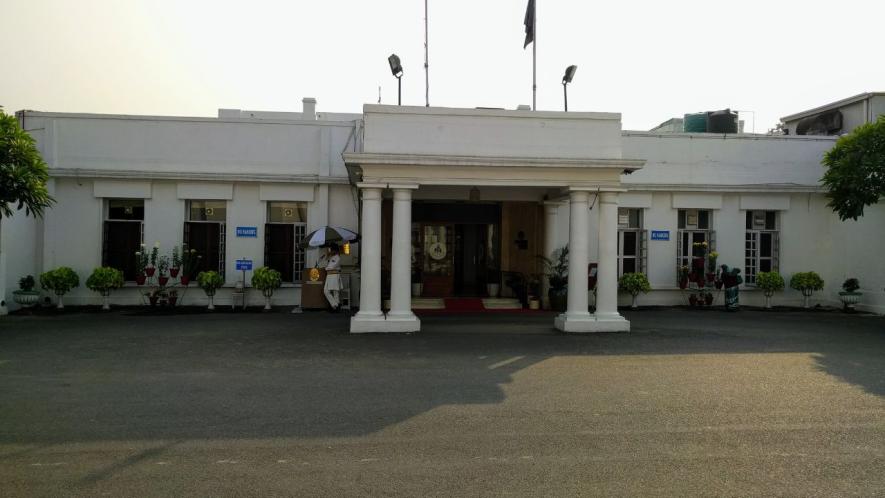
The main entrance of the Delhi Gymkhana Club. Image Courtesy: Wikimedia Commons
When the eDharti 2.0 portal was launched, the Ministry of Housing and Urban Affairs (MoHUA) presented it as a major step toward digitising land administration, reducing discretion and improving transparency in property management. Digital platforms have the potential to simplify processes, improve record keeping and reduce opportunities for corruption. However, questions remain about whether these objectives have been fully realised in the functioning of the Land and Development Office (L&DO).
A closer examination of lease administration, enforcement practices, and access to information suggests that digitisation alone has not resolved long-standing governance concerns. In several instances, the move from manual records to digital systems appears to have transferred existing institutional weaknesses into a new technological framework without adequately addressing underlying accountability gaps.
This raises an important public policy question: what has changed since the Comptroller and Auditor General (CAG) highlighted serious deficiencies in L&DO’s management of public land more than two decades ago?
The answer is mixed. While administrative processes have become increasingly digital, concerns regarding transparency, consistency of enforcement, recovery of public dues and public access to information continue to surface. The challenge is no longer simply one of paperwork; it is whether digital governance is being accompanied by the safeguards necessary to ensure accountability and public trust.
A Legacy of Loss: 26 Years of Ignoring CAG
The baseline of this administrative inefficiency was set in the CAG’s landmark 2000 report. The federal auditor exposed a broken administration: a chronic, deliberate weakness in tracking prime public lands, massive losses to the exchequer due to unrevised ground rents, and a complete failure to recover outstanding dues from high‑value institutional lessees who openly violated concessional lease terms.
More than two decades later, the script remains largely unchanged. The L&DO continues to operate through ad‑hoc, selective enforcement that works as an institutional shield for the elite. Consider the recent controversy around the 113‑year‑old Delhi Gymkhana Club. After decades of administrative silence, the L&DO suddenly swung into action, issuing an eviction notice and demanding ₹47.58 crore in unpaid dues for long‑running lease violations and unauthorised construction.
The principle that premium public land must serve the public interest is legally sound. But the timing of this sudden aggression—coming only after the National Company Law Tribunal (NCLT) took over the club’s management—exposes a deeply inconsistent, “pick‑and‑choose” style of enforcement that, in Delhi, has usually been reserved for slums and other so‑called “illegal” settlements.
If enforcement were truly blind, why does a quiet leniency still protect neighbouring elite defaulters? Take the India Habitat Centre: its exact lease compliance position has been kept opaque for years, with abrupt out‑of‑court settlements sidestepping any independent accounting of public wealth—even when parliamentarians had raised these very questions decades ago.
Where Verification Gaps Undermine Digitisation
Recent criminal investigations and FIRs illustrate how weaknesses in verification mechanisms can be exploited in land administration systems.
• The "Zombie SDM" case at Malcha Marg: In one reported matter, a property substitution process proceeded on the basis of documents that allegedly contained the forged signature and seal of a Sub-Divisional Magistrate who had ceased to hold the office years earlier. According to the FIR, the discrepancy was not detected during administrative processing and came to light only after the transaction had been completed.
• The High Commission forgery at Kautilya Marg: In another reported case, investigators examined allegations involving a forged conveyance deed relating to property associated with a foreign diplomatic mission.
• The Greater Kailash and Rajinder Nagar investigations: Ongoing Economic Offences Wing inquiries have examined allegations involving disputed title documents, powers of attorney, wills and property transactions that may have been used to create competing ownership claims over high-value properties.
These cases do not necessarily demonstrate systemic failure in every aspect of digitisation. They do, however, raise important questions about the adequacy of verification safeguards. Digital platforms can improve efficiency, but their effectiveness depends on the quality of underlying verification systems. If identity checks, document authentication and inter-agency data sharing remain weak, fraudulent documents may still enter official processes despite the presence of digital workflows.
The lesson is not that digitisation is ineffective, but that technology cannot substitute for institutional diligence. A robust digital governance framework requires real-time verification, cross-database integration and clear accountability mechanisms to ensure that administrative efficiency does not come at the expense of legal certainty.
Stonewalling Accountability: The RTI Breakdown
Public authorities are not owners of discretion; they are legal trustees of public resources. Under Section 4 of the RTI Act, public offices are required to proactively publish their rules, lease terms and financial liabilities so that citizens do not have to file formal RTI applications just to understand how public land is managed.
At Kasturba Gandhi Marg, however, the default response is silence. Public Information Officers (PIOs) routinely let the 30‑day RTI deadline lapse without sharing a single page of information or even fixing inspection dates. Even when the officials of L&DO are in contempt of the statutory timelines set by the very act. When citizens challenge this before the First Appellate Authority, the system leans on procedural delay—sitting on appeals and pushing public and the department into long, costly litigation before the Central Information Commission or the courts. This deliberate use of silence builds a wall around the office and keeps the deeper failures flagged by the CAG hidden from independent public scrutiny.
Rethinking Rhetoric and Reality
The contrast between official policy objectives and public experience deserves closer scrutiny. Enforcement actions against unauthorised constructions in urban villages, informal settlements and unauthorised colonies are often visible and immediate. By comparison, questions have periodically been raised regarding the pace and consistency of action taken against lease violations, outstanding dues and unauthorised constructions involving certain institutional occupiers of public land.
Whether this perception reflects reality can only be determined through greater transparency. The absence of publicly accessible compliance data makes it difficult for citizens to evaluate whether enforcement standards are being applied uniformly across categories of landholders.
At the same time, many ordinary leaseholders report prolonged delays in routine matters such as leasehold-to-freehold conversions, inheritance mutations and record corrections. Since the transition to digitised systems, applicants have frequently cited extended processing times, repeated deficiency notices and uncertainty regarding the status of pending applications.
L&DO maintains that digitisation initiatives are intended to streamline administration and improve service delivery. However, the effectiveness of such reforms ultimately depends not only on technology but also on transparency, responsiveness and consistent application of rules.
The broader concern is, therefore, not whether digitisation should continue, but whether digital governance is being accompanied by adequate public accountability. When citizens cannot easily access information regarding lease compliance, enforcement actions, outstanding dues or decision-making processes, confidence in the system inevitably suffers.
A transparent and accountable land administration framework should ensure that the same standards apply to all stakeholders, whether they are institutional occupants, commercial entities or individual households. The credibility of governance ultimately depends on the perception—and reality—that rules are enforced fairly and consistently.
The Path to Structural Accountability
To match the rhetoric of digital transparency with the reality of urban governance, the Union government needs to break the information wall around Lutyens Delhi through a few basic, non‑negotiable reforms:
· Independent audit of L&DO decisions
The CAG or the Central Vigilance Commission should conduct an external performance and vigilance audit of major institutional leases, embassy allotments and mutations cleared in the last decade, and fix officer‑wise responsibility for every serious lapse.
· Real‑time verification of documents
The eDharti 2.0 platform must be linked in real time with Sub‑Registrar offices, the Unique Document Identification system and key state revenue databases so that deeds are automatically verified, and manual verification gaps are removed.
· Public lease‑disclosure dashboard
In line with Section 4 of the RTI Act, there should be a public online dashboard showing lease terms, updated outstanding dues and breach status for all high‑value institutional allotments.
· End the conversion freeze for citizens
The indefinite freeze on residential leasehold‑to‑freehold conversion must be lifted, and a fast‑track window created to clear long‑pending family inheritance mutations.
Technology without transparency becomes just another form of opacity. If L&DO continues to sidestep judicial directions and shield elite violations, the public-spirited citizens of the country whose integrity can’t be doubted will have to turn to public interest litigation to enforce statutory duties and constitutional guarantees. It is time to restore real accountability to “all kinds” of land governance in the national capital.
The writer is the President of the Centre for Youth Culture Law and Environment (CYCLE), Delhi. The views are personal.
Get the latest reports & analysis with people's perspective on Protests, movements & deep analytical videos, discussions of the current affairs in your Telegram app. Subscribe to NewsClick's Telegram channel & get Real-Time updates on stories, as they get published on our website.