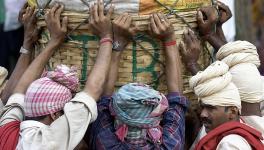






Gig Workers: Why Record Deliveries Do Not Mean Fair Work!

Image Courtesy: The Leaflet
‘New India’ is not a promise so much as a carefully manufactured myth, of seamless apps, instant gratification, and frictionless growth. It is a story that presents speed as progress and flexibility as freedom, while quietly resting on the exhaustion of those who keep the system running.
On December 31, that myth briefly cracked. On one of the busiest and most profitable nights in the platform economy, over two lakh gig workers across the country logged out. The nationwide strike, called by the Telangana Gig and Platform Workers Union and the Indian Federation of App-Based Transport Workers, with support from worker collectives across states, was a deliberate act of refusal.
As the rest of the country prepared to welcome the New Year with celebration and convenience, gig workers laid bare a more enduring reality, of declining pay, rising risk, and lives governed by opaque algorithms. This was not an isolated moment. An earlier strike on December 25 had already signalled that beneath the polished surface of digital India lies a labour regime built on disposability.
The strike was anchored in a clear and longstanding set of demands. In a formal letter addressed to the Union Minister of Labour & Employment, the Indian Federation of App-Based Transport Workers stated that nearly 40,000 delivery workers participated in a nationwide flash strike on December 25, resulting in significant service disruption across cities. The letter detailed a familiar pattern of exploitation: falling incomes despite longer hours, unsafe delivery models such as the push for ten-minute deliveries, arbitrary ID blocking, algorithmic penalties, and the routine denial of dignity, security, and voice.
Instead of addressing these grievances, platform companies responded with threats, deactivations, and attempts to break the strike through third-party interventions.
The demands placed before the government were neither excessive nor new: regulation of platform companies under labour laws, transparent and fair wages, an end to unsafe delivery timelines, social security including health and accident insurance, and protection of the right to organise and collectively bargain.
In defending the platform economy, Deepinder Goyal, CEO of Zomato, pointed to record deliveries on New Year’s Eve as evidence that the system works, that it is resilient, fair, and chosen. But volume is not a measure of functionality. That millions of orders were fulfilled on one of the most intense workdays of the year does not negate workers’ grievances; it underscores how deeply platform capitalism depends on uninterrupted labour, especially during moments of peak consumption. When logging out carries the risk of penalties, lost income, or deactivation, continued participation cannot be read as consent. It is endurance under constraint.
The claim that an unfair system would fail to “attract and retain” workers rests on a dangerous abstraction of choice. In cities marked by unemployment, informality, debt, and shrinking public employment, gig work often appears not as preference but as compulsion. Workers stay not because conditions are just, but because alternatives are scarce. To confuse survival with satisfaction is to erase the structural forces that funnel people into precarious work and keep them there.
Nowhere is this distortion clearer than in the push for 10-minute deliveries, a promise that has become emblematic of urban platform capitalism. If there is anything that should arrive in 10 minutes, it is an ambulance, not groceries or fast food. Yet, platforms have successfully transformed speed into a moral and economic imperative, manufacturing urgency where none exists. This urgency is not neutral. It reorganises city life around convenience for consumers while transferring risk onto workers’ bodies with longer hours, faster rides, greater exposure to accidents, and heightened stress, all in the service of instant gratification.
This is not merely a business model; it is a political economy of urban consumption. Platform companies thrive by converting everyday needs into moments of artificial emergency, where delay is framed as failure and slowness as inefficiency. In this regime, workers are disciplined not only by algorithms but by the constant pressure to keep the city moving, fed, and satisfied. That millions of orders were delivered on New Year’s Eve does not prove fairness. It reveals how deeply exploitation has been normalised as progress.
The December strikes were not a rejection of work, technology, or the city. They were a rejection of a system that demands speed without safety, flexibility without security, and work without rights. When gig workers logged out on December 25 and again on New Year’s Eve, they reminded us that convenience is never neutral and that progress cannot be measured only in orders delivered or minutes saved. These were not acts of disruption but of articulation: a collective insistence that labour in the digital economy must be recognised, regulated, and dignified.
If India’s platform economy is to claim the language of the future, it must confront the conditions of the present. A model that depends on manufactured urgency, precarious incomes, and the invisiblised endurance of workers is not sustainable, nor is it just. The choice before us is not between growth and labour rights, but between an economy that extracts until exhaustion, and one that values the lives that keep it running.
The writer is a Doctoral Researcher at the Department of Political Science, University of Delhi. The views are personal.
Get the latest reports & analysis with people's perspective on Protests, movements & deep analytical videos, discussions of the current affairs in your Telegram app. Subscribe to NewsClick's Telegram channel & get Real-Time updates on stories, as they get published on our website.