





India Lost 41 Per Cent of its Tiger Habitat Over the Last Two Decades
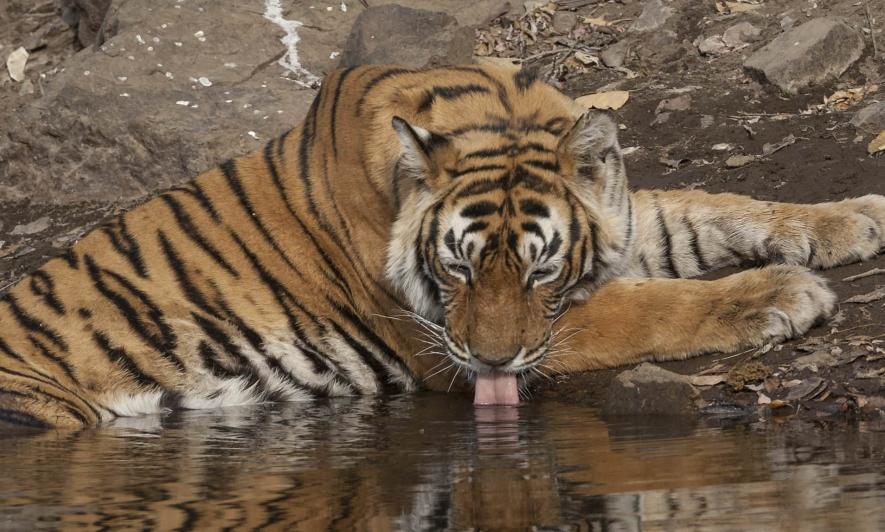
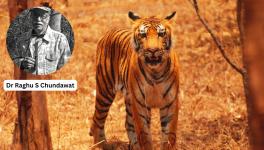
Image Courtesy: Daily Mail
Bhopal: India has lost 41% of its tiger habitat over the last two decades, according to the International Union for Conservation of Nature, keeping the tiger in its Red List of Threatened Species. The continuing dollar-maniac wildlife trade is a persisting threat to tiger populations, says 'Breathless', a book authored by journalist and wildlife enthusiast, Deshdeep Saxena, who researched the causes of decline in the number of tigers.
The book concludes that tigers are a potential prey to Global Warming. The book mentions that the biggest threat that tigers face is climate change.
The book comprises fourteen chapters which focus on the different dimensions of the tigers' life and death. It draws attention towards some potential threats to the life of tigers, the politics that surrounds them, and problems of conservation that demand immediate action from governments, wildlife experts and nature lovers. The book points out that the imminent loss of habitat in the near future will endanger the life of tigers.
Citing a study on the Sunderbans, the author says that the countdown for tigers has already begun. If rising sea levels are creating havoc for the Bengal tigers at Sunderbans, rising temperatures are leading to a slow and steady change in the type of forest cover in the vast habitat of Amur tigers in Russia’s Far East. In fact, countries that are home to the tiger, ranging from Russia to the South Asian nations, are going to be the worst affected by global warming.
The book mentions that parameters like temperature, precipitation, humidity and forest cover are changing rapidly, putting the habitat of tigers in danger. As a result, experts predict that the Siberian tigers could be extinct in the wild within a century.
The book also points out that the impact of climate change will directly threaten tiger habitats. Preserving their habitat, the author says, simply means that forests should stand untouched and green. This would mitigate the impact of climate change and give tigers a chance to fight.
Referring to some recent studies, the book warns that agriculture-dependent economies across south-east Asia would not only suffer from climate change, but also endanger human life and tigers as well. Demanding action, the author says that if these nations delay acting on climate change, their economies and their people will ultimately suffer. The impact would be enormous as south-east Asian nations form the world's fifth largest economy.
The book also speaks about the peculiar tendency of owning tigers as we would a commodity. It makes a surprising revelation that America is clueless about its tiger population. It points out that one can even purchase a tiger cub as a pet, saying that tigers in the United States are simply a dollar-fetching commodity.
Quoting the US Fish and Wildlife Service, the book informs that the US is home to more than ten thousand captive tigers. At least six of its states – North and South Carolina, Wisconsin, Nevada, Alabama and West Virginia – allow owning a tiger, while permits are required in fourteen states, with thirty states prohibiting ownership.
The book also poses an ethical question on the crossbreeding of tigers and lions and naming the progeny ‘Liger’.
Get the latest reports & analysis with people's perspective on Protests, movements & deep analytical videos, discussions of the current affairs in your Telegram app. Subscribe to NewsClick's Telegram channel & get Real-Time updates on stories, as they get published on our website.