





Venezuela, Imperial Power, and Politics of Captivity
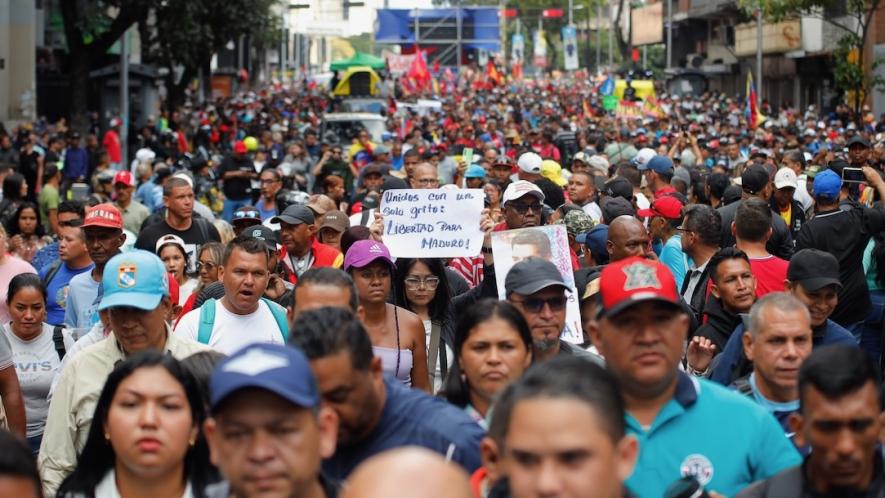
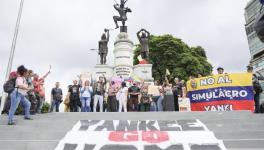
Mobilization in Venezuela for the return of President Nicolás Maduro from US captivity. Photo: Francisco Trias
On January 3, 2026, we crossed an international Rubicon. In a pre-dawn military operation dubbed Operation Absolute Resolve, the United States Armed Forces launched strikes across Venezuela, including in the capital, Caracas, and captured President Nicolás Maduro and his wife and comrade, Cilia Flores. Both were flown to the United States, where they now face prosecution on narcotics and related charges. Maduro remains in federal custody in Brooklyn, New York. This is not a misadventure in foreign policy. It is a declaration of imperial logic: when resources matter more than borders, the leaders of certain states become legitimate targets for capture and trial, not diplomats to be engaged.
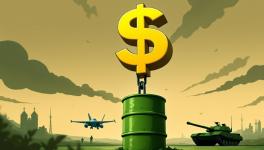
For decades, scholars have described Venezuela’s oil wealth as a “resource curse”: an economy over-dependent on a single commodity that stunted diversification, institutional robustness, and technological autonomy. But that formulation misses a deeper reality: resource abundance becomes a vector for vulnerability when it is unmatched by technological strength or strategic deterrence.
Venezuela did not build an economic base capable of leveraging oil into broad industrial or technological capacity. Instead, oil rents funded consumption and patronage, clutching the economy to one export and one price. When global markets shifted, the state did not fall; it became structurally exposed.
And when structural exposure converges with strategic geopolitical interest, the result is not merely economic fragility, but political capturability. This is what happened on January 3: a state with immense natural wealth but relative material inferiority to the hegemonic power that covets it. The resource curse was not only economic; it became political exposure writ large.
Imperial Logic: From Sanctions to Capture
The US policy toward Venezuela did not start on January 3. It was preceded by years of sanctions, financial pressure, diplomatic isolation, and the framing of Venezuela as a “crime state”. Sanctions, framed as non-violent alternatives to war, are now understood as preparatory coercion, preludes to kinetic action rather than substitutes for it. But what happened was not a lawful arrest warrant executed at The Hague or by Interpol. This was a military strike on a sovereign capital, executed by US forces, resulting in the apprehension of a sitting head of state and his spouse.
Under international law, heads of state enjoy immunity from prosecution while in office. What the US did was to treat that immunity as a discretionary privilege rather than a legal norm. From sanctions to capture, the logic is consistent: when power is asymmetrical, legality bends to fit strategy. When resources are in play, norms become negotiable.
Maduro’s Capture: Endangering Sovereignty
The implications are chilling. The abduction of a sitting president by foreign forces is not an isolated spectacle; it is a precedent. The last comparable event often cited is the 1989 US overthrow and detention of General Manuel Noriega in Panama, a military strongman whose capture was framed in anti-drug terms. But Noriega did not preside over a full republic with recognised constitutional legitimacy. Maduro did.
On January 3, international observers noted that the US itself acknowledged Maduro as the legitimate president even as it struck to detain him. If the global order cannot uphold the immunity of a head of state, even one it disfavours, it has ceased to be an order of law and become an order of power projection. Sovereignty becomes a commodity granted to some, withheld from others, negotiable on the basis of interest rather than principle.
Cuba, Iran, and Lessons of Coercion
Venezuela is not alone in this story. Cuba’s economic fortunes have long been linked to Venezuelan oil under Petrocaribe. When oil flows diminished due to Venezuela’s crisis and pressure, Havana’s own energy security faltered. This demonstrated how interdependent resource politics can amplify vulnerability for smaller states tied into larger geopolitical networks.
Iran has faced decades of sanctions aimed at throttling its oil revenues and technological development, effectively weaponising economic connectivity against sovereign autonomy. Tehran’s predicament shows how external pressure can distort national priorities, divert resources to survival rather than advancement.
In both cases, resource politics is not accidental; it is strategic. If oil can bring pressure to bear on Cuba or Iran, it can justify direct military action against Venezuela. The logic is cumulative, not exceptional.
Imperial pressure does not always wear combat fatigues. In the post-Cold War era, the US has wielded tariffs and trade policy as instruments of coercion. India’s recent tariff disputes over steel, aluminium, and other goods reveal how economic leverage is used to influence policy choices of rising economies, shaping global supply chains in ways that benefit dominant powers. The difference between India and Venezuela lies not in principle but in capacity: India’s diversified economy, technological advances, and geopolitical weight afford it resilience to some extent. Venezuela’s structural dependency on oil did not.
Politics of Fear and Future of Sovereignty
The capture of Maduro and Flores renders sovereignty as something verbalised but unenforced. When a great power can strike and detain a foreign leader without a broader legal mandate, the very idea of sovereign equality disintegrates. What remains is a hierarchy where the strong interpret law, and the weak experience it. This moment demands not sympathy for a specific leader, but a critical interrogation of the norms we are allowing to evaporate.
If sovereignty can be suspended for the sake of resource control, then every nation’s autonomy is at risk, especially those with valuable commodities and limited means to defend them.
Let us not mince words: what happened in Venezuela was not a law enforcement operation; it was a political act of dominion justified after the fact. When oil makes a state seizable, we must ask not just who lost power, but what it means to live in a world where resources trump rights, and power substitutes for law.
The writers teach Political Science at Akal University, Talwandi Sabo, Bathinda, Punjab, and Government Degree College Soibugh, Budgam, J&K, respectively. Thew views are personal. They can be reached at [email protected] and [email protected].
Get the latest reports & analysis with people's perspective on Protests, movements & deep analytical videos, discussions of the current affairs in your Telegram app. Subscribe to NewsClick's Telegram channel & get Real-Time updates on stories, as they get published on our website.