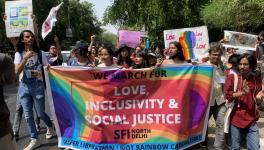






Pride, Power, and Future of Queer Politics in India
FIle Image
The Queer Movement in India has seen a remarkable shift in the past two decades. The legalisation of homosexuality in 2018 marks a historic victory for the queer community. The increased representation of the community in cinema and literature, and its consistent acceptance in the public sphere, deserve to be celebrated.
Yet the Pride Month (June) this year arrives under very different circumstances.
The Transgender Persons (Protection of Rights) Amendment Act, passed in March of this year, erased trans-inclusive definitions of transgender people put in place in the 2019 Act. It had the most adverse impact by making it mandatory for transgender people to get a certificate for their identity from a medical board. This erodes the right to self-perceived gender identity recognised by the Supreme Court in 2014, and transforms identity from a personal right to a status sanctioned by the State through a certification process. The amendment demonstrates how fragile recognition can be when the State retains the power to define identity. Rights that once were considered secure, can be questioned and reversed.
This raises a question that Pride celebrations often leave unanswered: what does Pride mean when recognition itself becomes politically uncertain?
For the past 20 years, the primary focus of queer politics in India has been recognition. The goals were visibility, legal legitimacy, and social acceptance. This approach brought important and positive changes. Queer identities became central in public discourse, and the discussions shifted toward their rights. Pride became a celebration of survival and a demonstration of political existence.
But political moments change. Queer movements today have different challenges than they did 20 years ago. Visibility alone no longer appears sufficient. Recognition of queer people hasn't ensured safety for them. The current moment suggests that even when queer people are publicly recognised, accepted, or granted certain legal rights, they may still lack the influence needed to protect those rights or shape political decisions. Recognition does not necessarily mean having real political power.
The resistance to the Transgender Amendment Act is already underway. Yet the consequences of the law are not borne equally. They fall most heavily on working-class transgender people for whom a State-issued certificate of gender is not merely a matter of recognition, but of access to healthcare, employment, housing, and welfare benefits. The amendment demonstrates that recognition is never simply symbolic. When the State acquires the power to define and verify identity, recognition becomes tied to access, survival, and citizenship itself.
The success of queer politics in India is evident all around us. Pride marches draw thousands, queer characters populate mainstream cinema, corporations proudly proclaim their commitment to diversity, and public institutions more than ever speak the language of inclusion. Recognition has transformed our social and political landscape.
Yet recognition has always contained a paradox. The State that recognises one’s identity is often the same that regulates it. Recognition expands rights, but it also works as a mechanism for the classification and governance of identities. Recent changes to transgender rights exemplify this paradox. Once recognised as a matter of self-identification, it increasingly becomes subject to processes of certification and verification.
This highlights the difference between recognition and power. Recognition acknowledges the existence of a community and might even grant it some legal protections. Political power, however, is the capacity to influence decisions, defend gains, and resist policies threatening those protections. A community might be publicly recognised and yet still vulnerable to a shift in the law, a change of government priority, or a new form of State intervention. Being able to secure rights does not equate to protecting them.
The challenge facing queer politics today is different from the challenge it faced 20 years ago. The central question is no longer whether queer people can enter public life, but how they can build forms of collective power that continue beyond moments of recognition. This involves thinking not just about inclusion, but also about influencing political decisions, resisting rollback and ensuring that the most vulnerable members of the community are not left exposed when recognition becomes uncertain.
One of the most significant developments of the past decade has been the expansion of queer concerns into broader struggles around caste, labour, gender violence and social justice. Queer activists increasingly participate in wider coalitions with feminist, Dalit, student and labour movements. This development raises an important challenge for Pride itself. If queer politics is becoming more deeply connected to other forms of marginalisation, then Pride cannot remain confined to the politics of recognition. Such coalitions may prove essential if queer politics is to move beyond recognition and develop the collective power necessary to defend rights when they come under threat.
The more important question is what Pride means after recognition.
The Pride Month isn't a lie. It is an incomplete truth. If the first phase of queer politics in India was about becoming visible, the next phase may have to confront a more difficult challenge. The question facing Pride today is no longer how queer people become visible, but how they build political power that can survive shifts in law, withstand state intervention, and remain accountable to those who have the most to lose.
The writer is a Research Scholar in the Department of Political Science, Panjab University, Chandigarh, specialising in gender, marriage, and sexuality studies. The views are personal.
Get the latest reports & analysis with people's perspective on Protests, movements & deep analytical videos, discussions of the current affairs in your Telegram app. Subscribe to NewsClick's Telegram channel & get Real-Time updates on stories, as they get published on our website.